
From beloved corner eateries to national chains, restaurants everywhere continue to teeter on the edge of survival due to COVID-19’s impact on public health and the economy. Recovery is proving to be an uphill battle, even with the relaxation of mask mandates for the fully vaccinated.
Welcoming back employees and diners will be increasingly challenging for restaurant owners as they seek to restore their pre-pandemic conditions. Vaccines, of course, are playing a huge role in protecting the health of employees and customers—and in 2020 we were served a first course on the effectiveness and legality of mandating inoculation for restaurant workers and dine-in guests.
Some view a vaccine mandate as a measure that helps ensure public safety and protects all those who want to serve or enjoy a meal; others perceive it as a recipe for civil-rights violations and liability lawsuits. Let’s look at how the industry has adapted—and could adapt—to the changing landscape of legal risk.
- Restaurant owners and in-house counsel face ongoing COVID-era risk as indoor dining returns, with 110,000 U.S. establishments closed and $240 billion in lost sales in 2020.
- Federal guidance allows employee vaccine mandates with required religious and disability accommodations, but flexible policies and incentives often reduce morale issues and liability exposure.
- States vary widely on COVID liability shields, making compliance with health directives critical to controlling litigation costs.
- The article outlines practical legal considerations that can help operators reopen faster, protect cash flow and stay competitive.
Restaurants by the Numbers
According to the National Restaurant Association, the restaurant and food-service industries employed 15.6 million people and had annual sales of $864.3 billion in 2019. When considering its broader impact, the foodservice industry—which also includes noncommercial restaurant services, military restaurant services, and various other places where people can purchase premade food—supports more than 21 million jobs and generates more than $2.5 trillion in annual economic activity as part of the national supply chain.
The pandemic’s arrival in the U.S. in early 2020 decimated a number of industries, though, restaurants chief among them, as those that survived the interruption were ordered to operate at limited capacity. The Restaurant Association reported that more than 110,000 eating and drinking establishments in the U.S. closed in 2020, causing a loss of 2.5 million jobs. Sales nationwide dropped by $240 billion from pre-pandemic levels.
With approximately 10 percent of the American workforce’s future hanging in the balance, restaurants’ recovery will help many related industries, providing a powerful, locally targeted tool to help reunite and rebuild communities across the country. It became clear in 2020 that restaurateurs would need to make tough decisions to attract and retain both employees and diners.
“Right now, restaurants across the country are . . . trying to figure out how to make ends meet when they are only allowed to fill 25 to 50 percent of their seats,” the Restaurant Association said in 2020, as federal economic support bills were being drafted. “They owe rent and have invoices for food that are past due. They are paying extraordinary prices for the safety measures they want to put in their dining rooms to keep their workers and patrons safe. And they are wondering how they will ever find the money to pay for it all.”
Injections, or Else?
A vaccination mandate, once shots became widely available, was one ambitious idea floated among a number of industries, particularly those dependent on in-person customer service. Some restaurant owners imposed requirements on their employees—and, in some cases, even on their guests. These initiatives engendered various degrees of compliance and pushback.
When the federal Centers for Disease Control and Prevention (CDC) released its recommended vaccine rollout plan in December 2020, it classified foodservice employees as part of phase 1C, one of the first eligible groups. This was welcome news for restaurateurs, who now had legal backing to better ensure a safe work environment. The Equal Employment Opportunity Commission (EEOC) allows employers to mandate the vaccine for their workers, with notable carve-outs:
• The employee must receive the vaccine at a third-party health-care provider or pharmacy that does not have a contract with the employer to administer the vaccine.
• The employer must make accommodations for religious and/ or disability-related objections under Title VII of the Civil Rights Act and/or the Americans with Disabilities Act.
They are paying extraordinary prices for the safety measures they want to put in their dining rooms to keep their workers and patrons safe.”
Many workers took advantage of their coveted spot in line and got vaccinated quickly, further flattening the curve and making indoor dining safer for staff and guests alike. Despite their overall effectiveness, though, vaccine mandates were also met with skepticism. Many legal experts suggested that restaurant owners should implement flexible policies that encouraged, rather than mandated, vaccination—both to minimize liability and support staff morale.
Giving employees incentives to get vaccinated proved an effective middle ground. Some restaurant franchises compensated workers with paid time off (PTO) for each dose received. Focus Brands—whose portfolio includes Moe’s Southwest Grill and Cinnabon— offered its workers two hours’ PTO for each dose; McDonald’s provided four hours per dose for corporate and instore employees alike.
Other employers and independent restaurateurs without powerhouse legal and risk departments created games or rewards to encourage their staffers to get inoculated. They could choose to impose a mandate on their patrons, too—but at a time when eateries were competing more ferociously than ever for the business of a drastically reduced number of diners, owners found themselves in a precarious position. How best to verify a customer ’s vaccination status, after all?
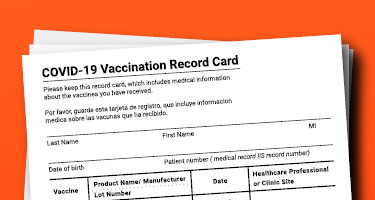
People have been broadly advised to carry their CDC cards (or a photograph thereof) to prove their status. Some states have offered alternatives to reduce friction: New York’s Excelsior Pass, for example, proved to be a secure way to present digital proof of vaccination or a negative test result.
Curbing the Public’s Litigation Hunger
The resumption of indoor dining will not be entirely smooth. COVID-19 infections remain a global risk. Studies suggest that the coronavirus can travel farther than the typical six-foot social distancing radius in a short time.
Indoor dining is unfortunately an ideal setting for this scenario. For example, a South Korean restaurant that experienced a small outbreak in 2020 gained attention for good reason: Korean researchers conducted interviews and investigated cellphone location data and closed-circuit television and found that the restaurant’s ceiling air conditioner was a major contributing factor to the outbreak. The unit pushed air from an asymptomatic diner directly toward two other diners sitting 21 feet away, who had been inside for only five minutes. These two diners subsequently tested positive for COVID-19. Air conditioning is needed for indoor dining, which only adds to the predicament for establishments hoping to reopen at full capacity.
Restaurants are the cornerstone of our communities, and our research shows a clear consumer desire to enjoy restaurants on-premises more than they have been able to during the pandemic.”
And though the risk of infection due to indoor dining is small, one burning question is whether patrons can sue if they contract COVID-19 while at a restaurant. No federal legislation limits COVID-related legal liability for business owners, but states have taken preemptive action to help protect businesses and, in many cases, passed laws to that end.
Oklahoma, Kansas, North Carolina, and Louisiana were among those that passed legislation rendering businesses immune from liability claims by those exposed to COVID-19 as long as no laws were violated and the person or business accused had followed official safety guidance. Several other states used similar language in bills to shield businesses from litigation as long as they follow official health directives and while the pandemic is still considered a national emergency (which it is, per President Biden’s continuance of the National Emergencies Act in February).
“Restaurants are the cornerstone of our communities, and our research shows a clear consumer desire to enjoy restaurants on-premises more than they have been able to during the pandemic,” says Hudson Riehle, a senior vice president at the National Restaurant Association. Referring to the group’s 2021 State of the Restaurant Industry Report, he adds: “With more than half of adults saying that restaurants are an essential part of their lifestyle, we are confident that, with time, the industry is positioned for successful recovery.”
Justin Smulison is a professional writer who regularly contributes to Best Lawyers. He was previously a reporter for the New York Law Journal and also led content and production for the Custom Projects Group at ALM Media. In addition to his various credited and uncredited writing projects, he has developed global audiences hosting and producing podcasts and audio interviews for professional organizations and music sites.