Insight

The Virtual Courtroom

Why some of the industry changes the pandemic has wrought—the advent of remote courthouse appearances chief among them—deserve to outlast the return to normal life.

White tiled floor with yellow desk and with yellow furniture
DT

Danielle E. Tricolla and Andrew E. Curto

September 16, 2020 08:00 AM

Like nearly all aspects of society, the American court system has been rendered almost unrecognizable by COVID-19. The pandemic forced the courts quickly and unexpectedly to transition to remote operations so that cases could proceed without attorneys, litigants, or even the judge setting foot inside a courthouse. This forced transition has revealed aspects of litigation that can be accomplished just as effectively—and far more efficiently—if done remotely.

Certain proceedings, such as trials and evidentiary hearings, might not be as adaptable to a virtual platform, but the majority of matters that have always required attorneys to be present—status conferences, compliance conferences, oral arguments on motions, and other routine things—can be completed remotely, in a fraction of the time.

Time

A court appearance for a routine conference usually consumes no fewer than two hours, even though the conference itself generally takes about 20 minutes. If your case is on for a 9:30 a.m. conference, unless it’s first on the calendar and all counsel are present for the first calendar call, it’s often 11 a.m. by the time your “9:30” begins. With virtual proceedings taking the place of daily calendar calls, and each case having a designated time slot, no longer must you spend an entire morning waiting for your case to be called.

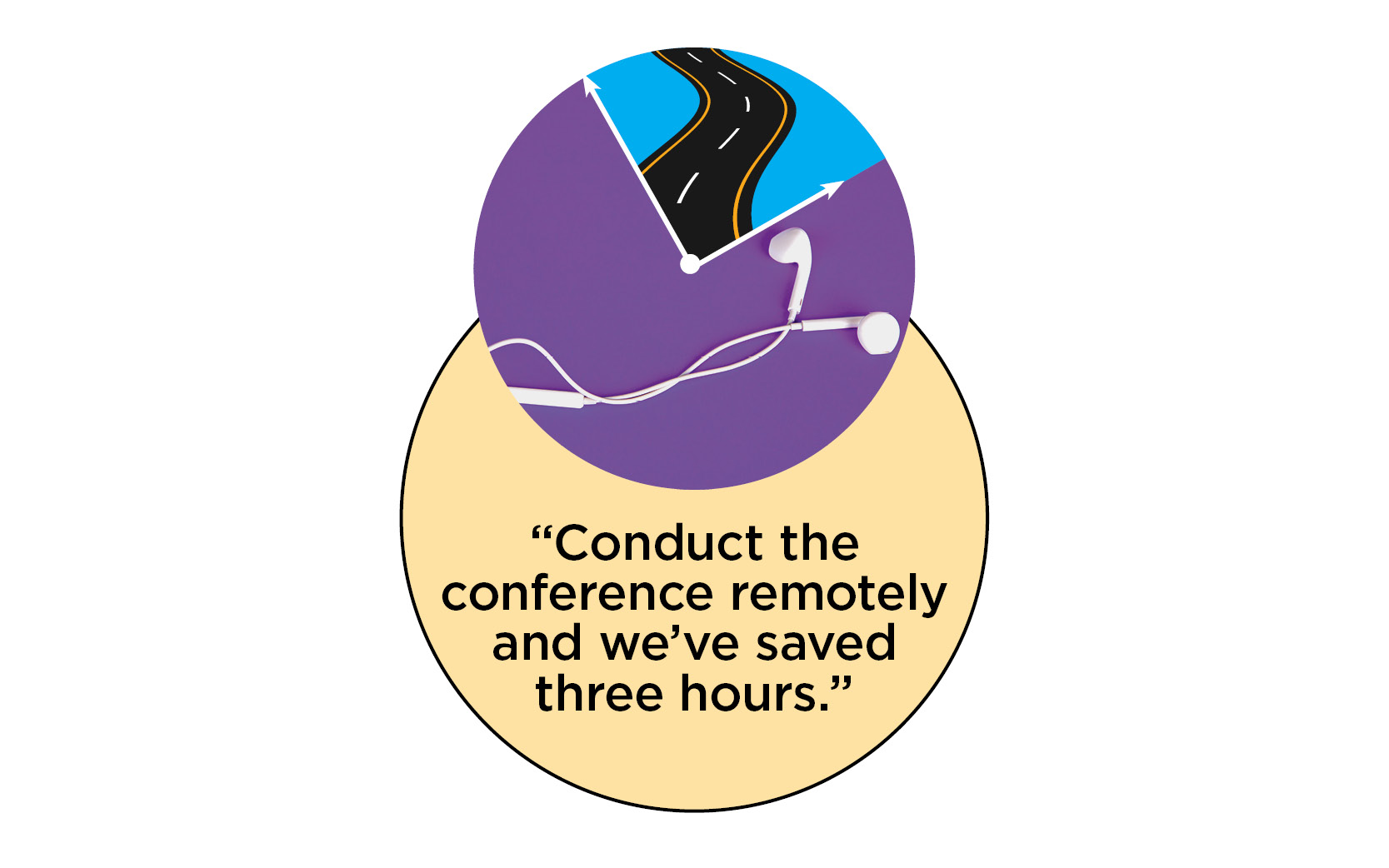
If your appearance is in another county, meanwhile, that 20-minute task can easily consume more than half your workday. It takes about 90 minutes to travel from our office in Nassau County, Long Island, to the courthouse in Suffolk, the neighboring county where many of our cases are venued. Conduct the conference remotely and we’ve saved three hours.

Virtual meetings of this sort are also more efficient for the court and all other cases on the court’s calendar that day, as they eliminate the delays incurred by attorneys stuck in traffic, riding a late train, having trouble parking, or scampering between courtrooms for multiple appearances.

Going remote will also reduce the number of wasteful appearances, such as those for which you travel 90 minutes, wait 90 minutes more for your case to be called, then learn that your adversary sent a per-diem or associate unfamiliar with the case to get an adjournment. If all routine appearances were held virtually, we expect there would be far fewer adjournments overall, with per-diem attorneys all but eliminated.

Scheduling will be easier, too, if routine appearances require only a brief video call. Indeed, it’s often difficult to find a date when all counsel and the court are available given how much time the parties must set aside. Remote counsel, by contrast, can attend multiple appearances in different cases in different counties all in a single morning.

Another potential benefit: Litigators are notorious for working long, late hours. Eliminating time-sucking court appearances can free up two to five hours a day, giving us more time to complete our other necessary work and, perhaps, find a better work-life balance.
Money

Virtual appearances mean less time traveling and less time waiting in court—which leads to fewer hours billed and, thus, a reduction in the overall cost of litigation.

This is great for clients, of course, especially those who have found litigation cost-prohibitive. A client of ours initially intended to forego her right to attorneys’ fees on a default judgment motion because it would cost nearly as much in additional legal fees for us to spend the day in court for the requisite inquest. By the time we filed her motion this May, however, all proceedings had gone virtual. What we initially expected to be a costly five-hour commitment might now take merely 30 minutes—time well-spent to recover the fees to which she’s entitled.

A reduction in billable hours might sound like bad news for lawyers, but in the long run it may have a net positive effect on business. If we reduce the overall cost of litigation, more people will be able to access and afford legal services.

As of late July, courts are already starting to resume in-person appearances, but before we settle back so quickly into our old ways, we ought to consider making the virtual courtroom a permanent fixture—not to replace the old ways entirely but as part of a more efficient, technologically advanced court system. Perhaps the all-encompassing disruption of recent months might ultimately help the wheels of justice to turn just a bit faster.

Andrew E. Curto is a partner and Chair of Forchelli Deegan Terrana LLP’s Litigation practice group. He has thirty years of experience handling complex commercial litigation and employment disputes. Mr. Curto is also outside general counsel to many multimillion-dollar companies using his litigation background in all facets of business conflict resolution, negotiations and problem solving.

Danielle E. Tricolla is an attorney in Forchelli Deegan Terrana LLP’s Litigation practice group. She handles a variety of business disputes and commercial litigation matters, including corporate dissolution and shareholder derivative actions, contract disputes, real property actions, regulatory compliance issues and employment claims. Ms. Tricolla earned her J.D. from New York Law School.
Headline Image: ISTOCK / MUSHAKLSA, PERFOTO, STARLINEARTS

Related Articles

Remote Controls


by Cynthia Morgan Ohlenforst

How law firms, lawyers and taxing authorities must adapt to remote work

Four lawyers sit around a circular at home due to COVID-19

Announcing the 7th Annual Women in the Law Publication


by Best Lawyers

The 7th Annual Women in the Law publication is a celebration of all the female legal talent across the country, honoring every woman listed in The Best Lawyers in America and Best Lawyers: Ones to Watch in America.

Cover title page of Best Lawyers Business Edition of Women in the Law; Spring 2022

Employment Entanglements


by Justin Smulison

As the United States approaches its third summer against the backdrop of the coronavirus, employers and employees still find themselves in a Gordian Knot of interconnected labor and employment challenges, with no clear way to untangle them all.

Cartoon man during COVID-19 changing the work environment on his computer and holding a briefcase

Legal Trends in the Modern Workplace


by Emma R. Schuering and Meghan H. Hanson

Employees are reevaluating their jobs and the workforce, including issues like pay equity, forced arbitration, paid time off, discrimination and other such policies as they continue to navigate a post-pandemic work life.

Cartoon graphic of a woman on the latter holding a shape trying to stack it

Hybrid Work - A Path for Female Lawyers


by Roberta Liebenberg

Remote work, flex time, some combination of both, all the rest of the pandemic’s new office normal: mere hype, or finally a meaningful option for female lawyers?

Half of an image of a desk and half an image of attorneys walking with a black and white filter

Navigating the New Normal


by Jody E. Briandi

The pandemic has upended many law firms’ internal culture and their lawyers’ work habits, in many ways for the better. As we approach 2022, how can we consolidate those positive effects to transform the practice of law (and our personal lives) for the better?

Close-up of Silver Door Handles with a blurred background

How I Adapt to Working From Home


by Alexandria Hurst

With the pandemic still ongoing with no end in sight, one lawyer writes about how she stays sane working from home.

Living room with chair and desk with an open laptop

Trending Articles

2026 Best Lawyers Awards: Recognizing Legal Talent Across the United States


by Jamilla Tabbara

The 2026 editions highlight the top 5% of U.S. attorneys, showcase emerging practice areas and reveal trends shaping the nation’s legal profession.

Map of the United States represented in The Best Lawyers in America 2026 awards

Gun Rights for Convicted Felons? The DOJ Says It's Time.


by Bryan Driscoll

It's more than an administrative reopening of a long-dormant issue; it's a test of how the law reconciles the right to bear arms with protecting the public.

Firearms application behind jail bars

2026 Best Lawyers Awards in Canada: Marking 20 Years of Excellence


by Jamilla Tabbara

Honoring Canada’s most respected lawyers and spotlighting the next generation shaping the future of law.

Shining Canadian map marking the 2026 Best Lawyers awards coverage

Revealing the 2026 Best Lawyers Awards in Germany, France, Switzerland and Austria


by Jamilla Tabbara

These honors underscore the reach of the Best Lawyers network and its focus on top legal talent.

map of Germany, France, Switzerland and Austria

Best Lawyers 2026: Discover the Honorees in Brazil, Mexico, Portugal, South Africa and Spain


by Jamilla Tabbara

A growing international network of recognized legal professionals.

Map highlighting the 2026 Best Lawyers honorees across Brazil, Mexico, Portugal, South Africa and Sp

How to Sue for Defamation: Costs, Process and What to Expect


by Bryan Driscoll

Learn the legal standards, costs and steps involved when you sue for defamation, including the difference between libel and slander.

Group of people holding papers with speech bubbles above them

Build Your Legal Practice with Effective Online Networking


by Jamilla Tabbara

How thoughtful online networking supports sustained legal practice growth.

Abstract web of connected figures symbolizing online networking among legal professionals

Algorithmic Exclusion


by Bryan Driscoll

The Workday lawsuit and the future of AI in hiring.

Workday Lawsuit and the Future of AI in Hiring headline

Blogging for Law Firms: Turning Content into Client Connections


by Jamilla Tabbara

How law firms use blogs to earn trust and win clients.

Lawyer typing blog content on laptop in office

Reddit’s Lawsuit Could Change How Much AI Knows About You


by Justin Smulison

Big AI is battling for its future—your data’s at stake.

Reddit Anthropic Lawsuit headline

How to Choose a Good Lawyer: Tips, Traits and Questions to Ask


by Laurie Villanueva

A Practical Guide for Your First-Time Hiring a Lawyer

Three professional lawyers walking together and discussing work

The 2026 Best Lawyers Awards in Chile, Colombia and Puerto Rico


by Jamilla Tabbara

The region’s most highly regarded lawyers.

Map highlighting Chile, Colombia and Puerto Rico for the 2026 Best Lawyers Awards

Common-Law Marriage in Indiana: Are You Legally Protected?


by Laurie Villanueva

Understanding cohabitation rights and common-law marriage recognition in Indiana.

Married Indiana couple in their home

Why Jack Dorsey and Elon Musk Want to 'Delete All IP Law'


by Bryan Driscoll

This Isn’t Just a Debate Over How to Pay Creators. It’s a Direct Challenge to Legal Infrastructure.

Elon Musk and Jack Dorsey standing together Infront of the X logo

AI Tools for Lawyers: How Smithy AI Solves Key Challenges


by Jamilla Tabbara

Understand the features and benefits within the Best Lawyers Digital Marketing Platform.

Legal professional editing profile content with Smithy AI

Alimony Explained: Who Qualifies, How It Works and What to Expect


by Bryan Driscoll

A practical guide to understanding alimony, from eligibility to enforcement, for anyone navigating divorce

two figures standing on stacks of coins