Insight

Bidding Wars: Understanding Federal Bid Protests

Federal government contracting can be convoluted. Here’s a primer on filing a bid protest for parties who think they’ve been wronged.

Businesspeople walking down the street with triangle grey shadows overcast
LL

Lori Ann Lange

November 4, 2021 06:25 AM

The vast majority of federal government contracts are awarded based on competitive procurements through either sealed bids or competitive proposals. Bidders in procurement, though, will occasionally come to believe the government’s solicitation was defective or the award decision unreasonable. In such cases, the unsuccessful bidder may want to file a bid protest. What does that entail?

Common Bases of Protest

Pre-award bid protests, generally, are challenges to the terms of the solicitation. Some common ones posit that:

  • The solicitation is unduly restrictive of competition (i.e., it contains unnecessary requirements that the bidder cannot meet or that favor one bidder over another).
  • The solicitation is ambiguous, contains conflicting terms or violates a statute or regulation.
  • The bidder did not have enough time to prepare a bid or proposal.

Post-award bid protests, by contrast, are typically challenges to the agency’s evaluation of the bids/proposals or the award decision, although the bases of post-award protests vary depending on whether the procurement was sealed-bid or competitive negotiation. Some common bases for sealed-bid procurements claim that:

  • The awardee’s bid was nonresponsive (i.e., it failed to conform to the solicitation’s essential requirements or specifications), or the agency improperly determined that the protester’s bid was nonresponsive.
  • The awardee failed to meet definitive responsibility criteria (e.g., a license, permit or level of experience), or the agency improperly determined that the protester did not meet definitive responsibility criteria.
  • The awardee’s bid was late, or the agency improperly determined that the protester’s low bid was late.

Some common bases of post-award protests on competitively negotiated procurements include claims that:

  • The agency’s evaluation of proposals or its award decision was unreasonable or not in accordance with the evaluation criteria.
  • The agency used unstated evaluation criteria.
  • The agency failed to conduct meaningful discussions with the protester (i.e., did not identify significant weaknesses or deficiencies in the proposal).

Who Can Protest?

To file a protest, the protester must be an interested party. An interested party is an actual or prospective bidder whose direct economic interest would be affected by the award or failure to award a contract. For pre-award protests, any bidder who intends to submit a bid is an interested party. For post-award protests, any bidder who would be in line for award if the protest were sustained is an interested party.

Where Can a Protest Be Filed?

Bid protests can be filed in three forums: (1) the agency that issued the solicitation; (2) the Government Accountability Office (GAO); or (3) the Court of Federal Claims (COFC). Agency-level protests can be filed with the contracting officer or a level above the contracting officer.

There are pros and cons for each forum.
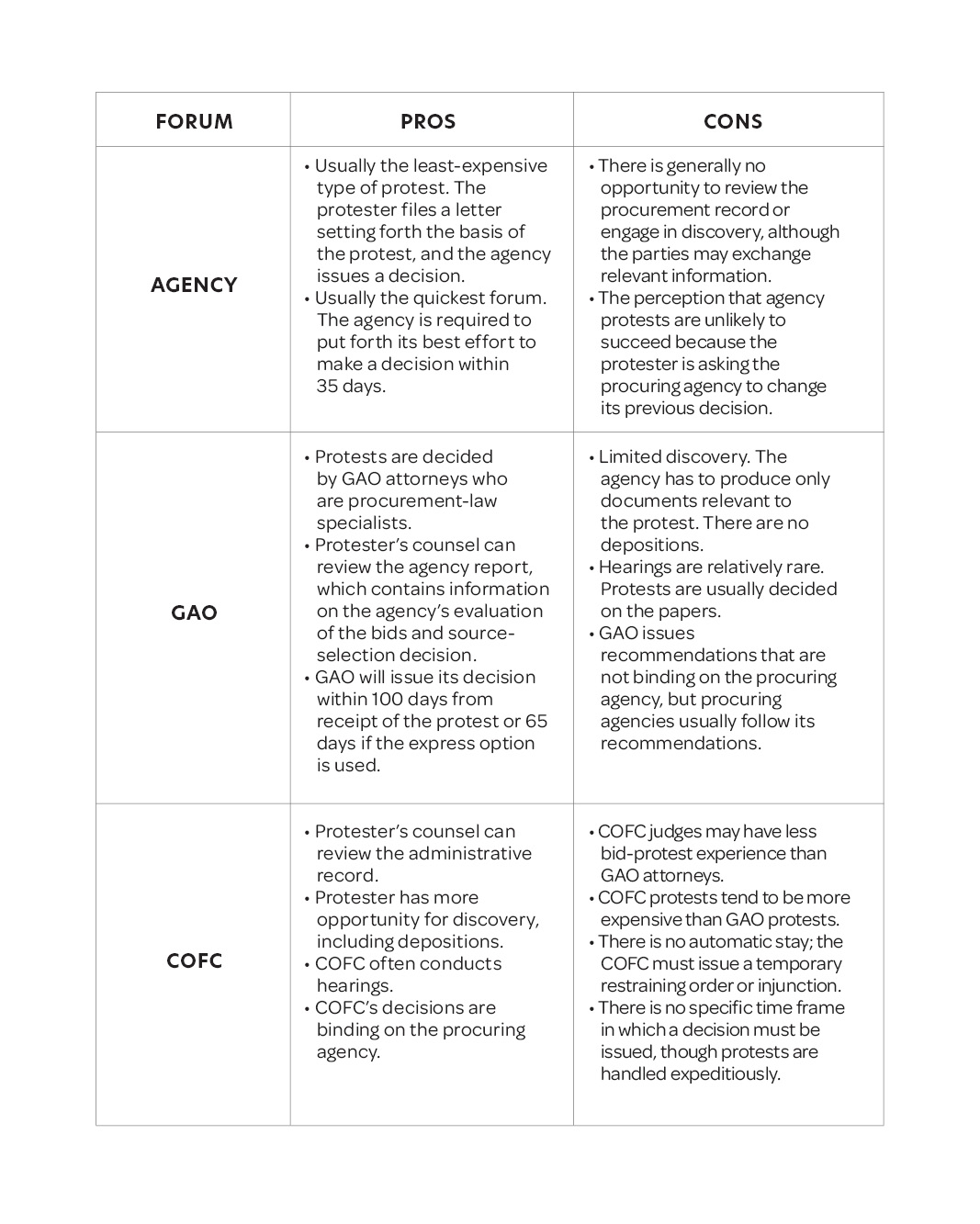
Bidding Wars Article Chart 1

Time to Protest

There are complex rules about when pre-award and post-award protests must be filed, and late protests will almost always be dismissed. Below is some general information, but the protester should consult with counsel regarding the applicable time frame in which to file a protest.
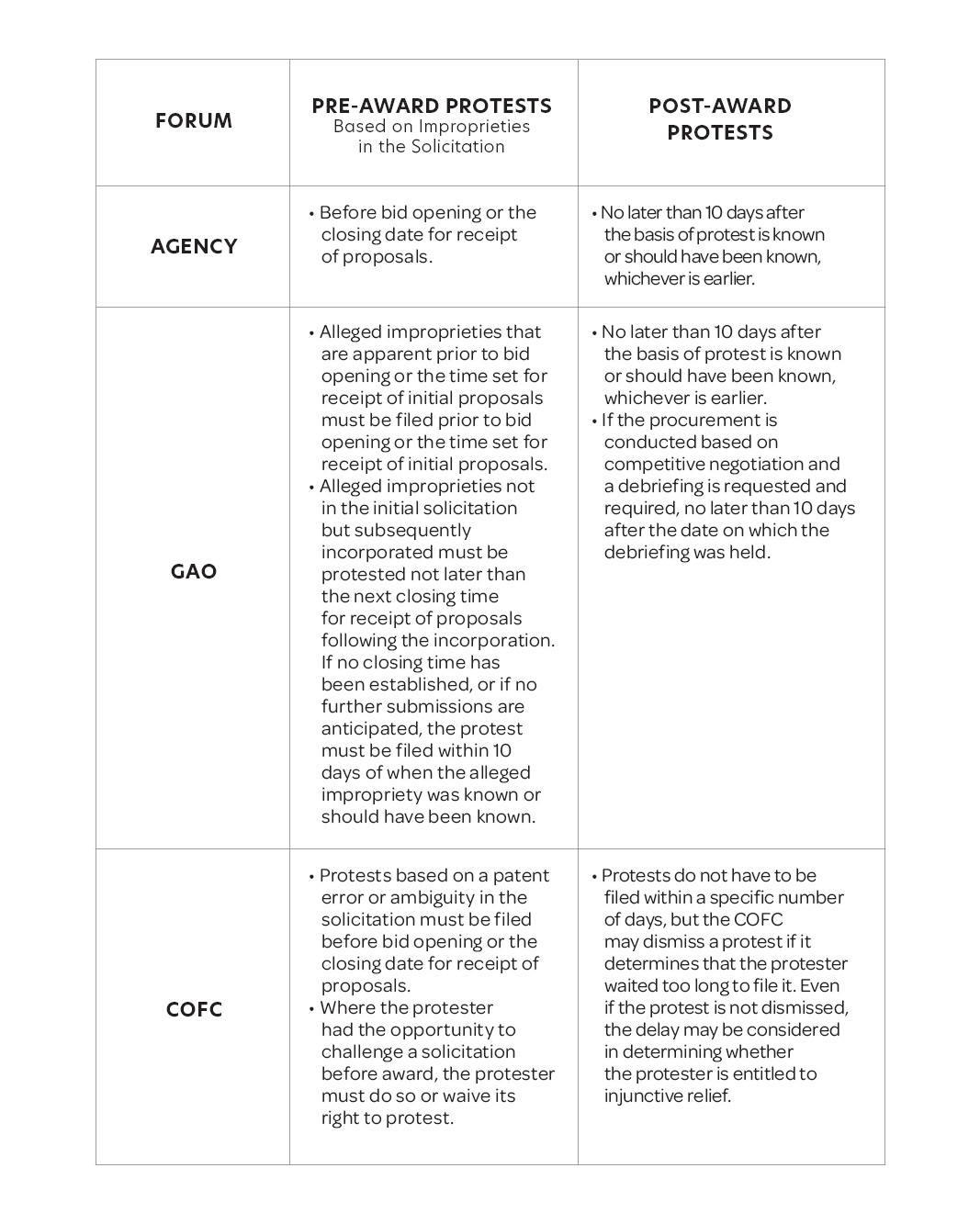
Bidding Wars Inline Image 2

Automatic Stay

When in place, an automatic stay stops the agency from awarding the contract if it has not yet been awarded or from permitting the contractor to perform the work if the contract has been awarded while the protest is pending. Automatic stays are available in both agency and GAO protests. There is no automatic stay in COFC protests; instead, the protester must seek a temporary restraining order and injunction.

To be granted an automatic stay, the protester must follow strict timing requirements. If the award has not yet been made, filing the protest will stay the award of the contract. If the award has been made, filing the protest will stay performance of the contract if the agency protest is filed or the GAO notifies the agency that a protest has been filed within: (1) 10 days after contract award; or (2) five days after a debriefing date offered to the protester when the protester made a timely request for a required debriefing. The agency, however, may override the automatic stay if it determines that there are “urgent and compelling” circumstances.

Protest Remedies

Protest remedies can vary to a certain extent based on the protest forum. In agency protests, the agency may act upon the recommendation of the GAO if the protest was filed there, as well as pay appropriate costs, which typically encompass the costs of filing and pursuing the protest, including reasonable attorney, consultant and expert witness fees. The agency also may pay bid and proposal preparation costs, though agencies generally will not pay these if the protester, as part of the remedy, will be given another opportunity for its bid or proposal to be considered for award. The agency will not pay lost profits.

The GAO may recommend as well that the agency do one or more of the following:

  1. Refrain from exercising options under the contract;
  2. terminate the contract;
  3. recompete the contract;
  4. issue a new solicitation;
  5. award a contract consistent with statute and regulation; or
  6. issue any other recommendation(s) that GAO determines necessary to promote compliance.

The GAO may recommend that the agency reimburse the protester for the cost of filing and pursuing the protest, including attorneys’ fees and consultant and expert witness fees, although usually at a reduced hourly rate. It may also recommend that the agency pay the protester its bid and proposal preparation costs in those limited circumstances in which the protester will not have another opportunity for its bid or proposal to be considered for award. The GAO will not recommend that the protester receive lost profits.

The COFC may award any relief that it considers proper. Monetary relief is limited to bid preparation and proposal costs. Regarding attorneys’ fees, the COFC can award attorneys’ fees only under the Equal Access to Justice Act (EAJA) to a limited class of protesters. Under the EAJA, a protester is entitled to attorneys’ fees only if the following conditions are met:

  1. The fee application is submitted within 30 days of final judgment and is supported by an itemized statement;
  2. at the time the protest was initiated, the protester, if a corporation, must not have been valued at more than $7 million in net worth or employed more than 500 employees;
  3. the protester is the prevailing party;
  4. the government’s position was not substantially justified; and
  5. no special circumstances exist that would make an award unjust.

Conclusion

If a disappointed bidder believes that a procurement was conducted unfairly or the award decision was flawed, filing a bid protest can provide the bidder with another opportunity to potentially obtain an award. Protesters need to carefully review their options for where (and when) to file a protest. Bid protest rules can be complex; as such, protesters should discuss their options with experienced bid protest counsel.


Lori Ann Lange is a Partner and serves as Co-Chair of Peckar & Abramson's Government Contracting & Infrastructure practice, leading the firm's federal government contracting efforts. She specializes in government contract law, bid protests, and corporate compliance counseling. Lori represents a range of government contractors, including construction contractors, major defense contractors, informational technology contractors, and service contractors.


Related Articles

Unenforceable HOA Rules: What Homeowners Can Do About Illegal HOA Actions


by Bryan Driscoll

Not every HOA rule is legal. Learn how to recognize and fight unenforceable HOA rules that overstep the law.

Wooden model houses connected together representing homeowners associations

What Is the Difference Between a Will and a Living Trust?


by Bryan Driscoll

A practical guide to wills, living trusts and how to choose the right plan for your estate.

Organized folders labeled “Wills” and “Trusts” representing estate planning documents

Do You Need a Real Estate Attorney to Refinance?


by Bryan Driscoll

When and why to hire a real estate attorney for refinancing.

A couple sitting with a real estate attorney reviewing documents for refinancing their mortgage

How to Get a Power of Attorney


by Bryan Driscoll

Learn the steps to set up a power of attorney, the risks of DIY forms and how to choose the right person to act on your behalf.

A couple discussing power of attorney paperwork with a lawyer

IN PARTNERSHIP

Breaking Down Criminal Conviction in Canada


by Mass Tsang

Statistics Canada’s annual breakdown of adult criminal court data provides an eye-opening review of how the country’s court system resolves its hundreds of thousands of cases annually.

Silhouettes of Officer walking with two men on a strip of concert

IN PARTNERSHIP

Things to Consider When Choosing a Sexual Assault Lawyer in Ontario


by Igor Vilkhov

Choosing the right lawyer when faced with sexual assault charges is important. Here are a few things to consider.

Vilkhov Law attorney sits in the dark with a black and white filter

Alimony Explained: Who Qualifies, How It Works and What to Expect


by Bryan Driscoll

A practical guide to understanding alimony, from eligibility to enforcement, for anyone navigating divorce

two figures standing on stacks of coins

Should I Get a Prenup? A Guide for Couples


by Bryan Driscoll

Prenuptial agreements aren’t just for the wealthy. Here’s what they do, when you might need one and how to decide if it’s right for your relationship.

Prenuptial agreement with pen

How to Sue for Defamation: Costs, Process and What to Expect


by Bryan Driscoll

Learn the legal standards, costs and steps involved when you sue for defamation, including the difference between libel and slander.

Group of people holding papers with speech bubbles above them

How to Get a Patent


by Bryan Driscoll

A comprehensive guide to understanding patents, the application process and strategies to protect your invention in the U.S.

Illustration of a person with an idea next to a lawyer holding patent documents

How to Choose a Good Lawyer: Tips, Traits and Questions to Ask


by Laurie Villanueva

A Practical Guide for Your First-Time Hiring a Lawyer

Three professional lawyers walking together and discussing work

How Best Lawyers Connects You With Trusted Legal Counsel


by Jennifer Verta

Discover how Best Lawyers simplifies the attorney search process.

A focused woman with dark hair wearing a green top and beige blazer, working on a tablet in a dimly

Inflation Escalation


by Ashley S. Wagner

Inflation and rising costs are at the forefront of everyone’s mind. The current volatile market makes it more important than ever to understand the rent escalation clauses in current and future commercial lease agreements.

Suited figure in front of rising market and inflated balloon

IN PARTNERSHIP

Coffey Burlington's Legal Expertise


by John Fields

Service. Integrity. Results.

Coffey Burlington 2025

IN PARTNERSHIP

Elevating Our Cases Into Causes


by Justin Smulison

Two female attorneys

IN PARTNERSHIP

Federal Employee Advice: I’ve Been RIF’d. Now What?


by Bernabei & Kabat

What to do after a Reduction in Force

Two toy people being held in the palm of someone's hand above a group of other toy people

Trending Articles

2026 Best Lawyers Awards: Recognizing Legal Talent Across the United States


by Jamilla Tabbara

The 2026 editions highlight the top 5% of U.S. attorneys, showcase emerging practice areas and reveal trends shaping the nation’s legal profession.

Map of the United States represented in The Best Lawyers in America 2026 awards

Gun Rights for Convicted Felons? The DOJ Says It's Time.


by Bryan Driscoll

It's more than an administrative reopening of a long-dormant issue; it's a test of how the law reconciles the right to bear arms with protecting the public.

Firearms application behind jail bars

2026 Best Lawyers Awards in Canada: Marking 20 Years of Excellence


by Jamilla Tabbara

Honoring Canada’s most respected lawyers and spotlighting the next generation shaping the future of law.

Shining Canadian map marking the 2026 Best Lawyers awards coverage

Revealing the 2026 Best Lawyers Awards in Germany, France, Switzerland and Austria


by Jamilla Tabbara

These honors underscore the reach of the Best Lawyers network and its focus on top legal talent.

map of Germany, France, Switzerland and Austria

Best Lawyers 2026: Discover the Honorees in Brazil, Mexico, Portugal, South Africa and Spain


by Jamilla Tabbara

A growing international network of recognized legal professionals.

Map highlighting the 2026 Best Lawyers honorees across Brazil, Mexico, Portugal, South Africa and Sp

How to Sue for Defamation: Costs, Process and What to Expect


by Bryan Driscoll

Learn the legal standards, costs and steps involved when you sue for defamation, including the difference between libel and slander.

Group of people holding papers with speech bubbles above them

Build Your Legal Practice with Effective Online Networking


by Jamilla Tabbara

How thoughtful online networking supports sustained legal practice growth.

Abstract web of connected figures symbolizing online networking among legal professionals

Algorithmic Exclusion


by Bryan Driscoll

The Workday lawsuit and the future of AI in hiring.

Workday Lawsuit and the Future of AI in Hiring headline

Blogging for Law Firms: Turning Content into Client Connections


by Jamilla Tabbara

How law firms use blogs to earn trust and win clients.

Lawyer typing blog content on laptop in office

Reddit’s Lawsuit Could Change How Much AI Knows About You


by Justin Smulison

Big AI is battling for its future—your data’s at stake.

Reddit Anthropic Lawsuit headline

How to Choose a Good Lawyer: Tips, Traits and Questions to Ask


by Laurie Villanueva

A Practical Guide for Your First-Time Hiring a Lawyer

Three professional lawyers walking together and discussing work

The 2026 Best Lawyers Awards in Chile, Colombia and Puerto Rico


by Jamilla Tabbara

The region’s most highly regarded lawyers.

Map highlighting Chile, Colombia and Puerto Rico for the 2026 Best Lawyers Awards

Common-Law Marriage in Indiana: Are You Legally Protected?


by Laurie Villanueva

Understanding cohabitation rights and common-law marriage recognition in Indiana.

Married Indiana couple in their home

Why Jack Dorsey and Elon Musk Want to 'Delete All IP Law'


by Bryan Driscoll

This Isn’t Just a Debate Over How to Pay Creators. It’s a Direct Challenge to Legal Infrastructure.

Elon Musk and Jack Dorsey standing together Infront of the X logo

AI Tools for Lawyers: How Smithy AI Solves Key Challenges


by Jamilla Tabbara

Understand the features and benefits within the Best Lawyers Digital Marketing Platform.

Legal professional editing profile content with Smithy AI

Alimony Explained: Who Qualifies, How It Works and What to Expect


by Bryan Driscoll

A practical guide to understanding alimony, from eligibility to enforcement, for anyone navigating divorce

two figures standing on stacks of coins