I have two visible scars on my body. The first I earned when I was 4 years old, when a midcentury gray steel desk tipped over on me while my little brother and I were trying to climb it. The resulting stitches left a long horizontal scar on the bridge of my nose.
The second came from an accident at age 13. That episode was far more serious.
Growing up in the 1980s and ’90s in Mobile, Alabama was a lot of fun. We had the kind of freedom that Generation X and our parents, the Baby Boomers, enjoyed as kids. We rode our bikes everywhere, built forts, explored the woods, and stayed outside as late as our parents would let us—usually until the streetlights came on and the crickets started chirping.
My generation had it all: fun, adventure, technology, video games, and, unfortunately, trips to the emergency room. I was no exception. I rode a bike without helmet or shoes. I climbed trees, slammed my fingers in our sliding glass door on a semi-regular basis, and always had a bruise or skinned knee. It was all fun to me, even (mostly) my visits to the ER.
Time and experience have a way of lending perspective, though, and I now wonder: How did I make it out of those two formative decades alive?
With perspective comes a sense of gratitude and a desire not to take anything for granted. Any one of my accidents could have been tragic, as similar mishaps have been for countless families. As such, I have a heightened appreciation for the work done by attorneys and product-safety activists who have helped make everyday life a little safer for children.
The tale of my second scar is one I can’t forget—and it has a backstory far more terrifying than I could ever have imagined when I was in middle school.
The Honda Big Red—100 Kinds of Fun
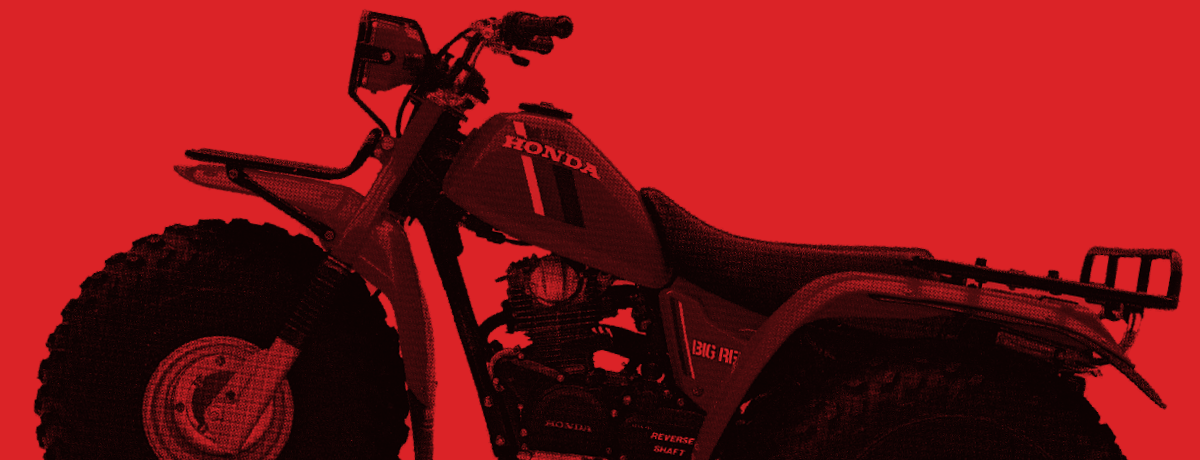
As a kid, I never thought of our 1985 Honda Big Red ATV, with its three giant tires, as particularly dangerous; it had been a fixture at our home for as long as I could remember. Dad used it often for hunting or hauling things around the property. It was irresistible to us—what kid wouldn’t love a giant red motorcycle with a third wheel, like a trike, and oversized, crush-everything tires? Honda three-wheelers, known by the brand’s trademarked term “All Terrain Cycle” (ATC), were marketed to the whole family for outdoor fun while still being practical for farm work. Early advertisements for the Honda ATC showed adults and children riding three-wheelers together as if they were in were no inherent danger at all. One of the early-’80s commercial featured a jingle, “going three-wheeling,” that played as the narrator said, “Do you know why Honda makes nine different kinds of easy-to-ride three-wheelers? So your family can have a hundred kinds of fun.”
Looking back, the ads were truthful in one regard: Three-wheelers were a hundred kinds of fun. Until you ended up in the hospital.
In December 1994, I was a 13-year-old looking for a cure for boredom. It was cold, just a few days before Christmas, and my brother and I thought it would be fun to take the Honda out for a spin around our property. After he drove it for a few minutes, I hopped on and went around the yard several times. As I got used to driving it, I increased my speed—the Big Red, like most similar vehicles, could get up to around 55 miles per hour—and changed my route slightly. My fun was cut short when I took a corner too fast and too close to a tree.
I don’t remember much about the crash itself, other than that it was violent and happened quickly. I remember the aftermath well, though. I opened my eyes and gasped for air but felt like I was suffocating. I couldn’t scream or even call for help. My brother and dad, who were both nearby, ran over to me, and the next thing I knew, Dad was on the phone with Mom as she directed him through an assessment of my injuries. I had severe bruising everywhere, cuts and scrapes, and a large gash on my right leg. At the time, my mom was an emergency-room nurse; she was at work when they rushed me in and had to stand back and watch her colleagues work on her only daughter, who was ghost-white and in very rough condition.
Scans showed that my liver had been damaged and I was bleeding internally, though the bleeding appeared to be subsiding. I was taken to the intensive-care unit for monitoring, not fully understanding just how perilous my situation was. I knew I was in a lot of pain. I knew the wound on my leg was far too mangled for mere stitches. But I had no concept of the severity of my injuries or of the amazing things my body was doing to keep me alive—and eventually to make a full recovery, marked only by an ugly scar on my lower leg. I certainly had no inkling of what my parents were going through.
I’ll never forget lying in my ICU bed watching the TV mounted high on the wall, the room dim except for the glow of the screen, the lights around the nurses’ station, and the illumination from the equipment in my room. And there was Dad, every single day, sitting beneath the TV with a look on his face that I can only describe as “lost.” His stern “tough guy” persona had melted way and all I could see was the love he had for me. I now realize he bore the look of a terrified father possibly replaying what he might have done to prevent what happened. I say “possibly” because to this day, 27 years later, I haven’t asked him what he was thinking. I can barely make sense of how I feel about it.
The only thing I know for sure is that I would have hated to leave this earth without telling my parents they were the absolute best, and that this wasn’t their fault. I think of the many other parents who have experienced grievous loss from incidents like mine and never heard their kids tell them, “It was just an accident—these things happen, and no parent can prevent all bad things from happening to their kids.”
Off the Market, Under Duress
My parents were extremely cautious and often overprotective, but what happened to me was part of a troubling pattern of children getting hurt or killed in three-wheeler accidents. That history dates to the 1970s, when three-wheeler ATVs first entered the U.S. market. By the early ’80s, three-wheelers were a hot item, with sales increasing approximately 400 percent between 1980 and 1983. As their popularity increased, so did emergency-room visits and deaths.
U.S. government memoranda from the mid-’80s outline disturbing findings regarding three-wheelers’ design. For example, their oversized, balloon-like tires would cause the vehicle to bounce on rough, uneven surfaces, eliminating the driver’s ability to control the ATV given that the steering mechanism, the front wheel, was no longer in contact with the ground. Sudden braking while turning could cause an ATV to capsize. The vehicle could lose power when climbing a hill, then coast back down and roll over. In a number of cases studied by the government, drivers were thrown off their ATV into trees or poles when they tried to brake and turn away. In addition, the vehicle’s configuration allowed for a rider’s foot to get caught under a tire if the rider put a foot on the ground while the ATV was moving.
“Most accidents occur as a result of wheels striking an object or encountering a sudden change in terrain which was not perceived in time to be avoided,” the government report noted. “These objects and sudden changes in terrain cause the ATV to respond in a manner which the driver cannot control, resulting in the victims being thrown from the ATV.”
In 1987, seven years before my wreck, Honda executive Tetsuo Chino testified in the personal injury trial of a boy who was 14 when he fell off a Honda ATC 110 three-wheeler driven by an 8-year-old. The older boy suffered a traumatic brain injury and, at the time of the trial, had a vocabulary reduced to just 40 words. Chino broke down in tears as San Diego attorney Craig McClellan gave him a list of 789 people, half of them children, who had died in accidents involving Honda ATVs.
That same year, Honda and other manufacturers voluntarily ceased production of three-wheelers due to safety concerns and the threat of prosecution. The result was a consent decree in which the companies agreed to a 10-year production moratorium and agreed as well to finance a multimillion-dollar ATV safety campaign. On April 27, 1988, the U.S. District Court for the District of Columbia issued a memo approving the final consent decrees submitted in The United States v. American Honda Motor Co., et al. Marcia Sowles, trial attorney with the Federal Programs Branch Civil Division, thanked McClellan, saying that “the information you provided regarding Honda was very helpful in building the government’s case in this extremely important safety problem.”
While the 10-year moratorium has long since expired, a 2008 federal law, H.R. Bill 4040 (Sec. 232), prohibits the importation of new three-wheel ATVs until new standards of safety can be drafted and implemented. As of 2021, no standards have been drafted and it seems unlikely that manufacturers will pursue the matter, given the liability concerns and the fact that 4-wheeler ATVs have proved to be a popular alternative. My accident occurred years after McClellan, victims’ families, other personal injury attorneys, and the federal government worked with manufacturers to end the sale of these vehicles. Unfortunately, accidents didn’t cease in the wake of the consent decree, and I was one of the many victims never fully aware of the risks three-wheelers presented.
My accident never made it to an attorney’s desk and, as far as I’m aware, was never even reported.
We Had It All—Including Great Lawyers
I have a wonderful, loud, obnoxious family who all love to laugh—Mom, Dad, four younger brothers, their spouses, my husband, nieces and nephews. We enjoy taking jabs at one another, and, of course, the tale of the time I wrecked Dad’s three-wheeler routinely comes up. I take it in stride but always say the same thing: “They took three-wheelers off the market for a reason.” And although I’ve said this for years, I never really stopped to appreciate the “they” to whom I refer. The wonderful attorneys and others who have pushed for safer furniture that doesn’t tip over, bicycle safety, toy safety, you name it—they’ve changed the world.
We Millennials truly did have it all—and while there might be a part of me that would like to see kids today have the kind of fun outdoors that we had, I’m grateful that these outstanding people continue to push for better product safety. We’ll never know how many kids are alive today because of their efforts.
Rachel A. Shrewsbury grew up in Mobile, Alabama and now lives in Augusta, Georgia with her husband, Greg, and long haired piebald mini dachshund, Aubrie. A graduate of the University of Alabama, Rachel’s 14-year marketing career has ignited her passion for writing and storytelling. Today she is a member of the Best Lawyers marketing team where she focuses on content marketing and digital marketing strategy.
Concerned about product safety or recovering from an accident? Use the Best Lawyers Find a Lawyer tool to connect with attorneys experienced in personal injury and product liability cases.