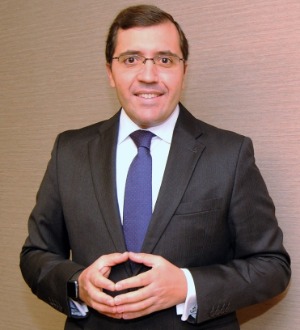
Efrén Díaz Díaz
Awarded Practice Areas
Biography
Efrén Díaz Díaz is a Lawyer and Doctor of Law. Senior Associate at Mas y Calvet Law Firm (Madrid). Head of the Technology and Space Law Areas of the Mas y Calvet Law Firm.
Data Protection Officer in Europe in the financial, legal, health, geospatial and educational sectors.Specialist in Administrative, Technological and Geospatial Law, he develops tasks in regulated sectors, technology, foundations, geospatial coordination Cadastre-Property Registry, public and private contracting, contracting of Internet domains, intellectual property and data protection, legal defense of reputation corporate and business.
Currently, Efrén Díaz is:
- Doctor of Law from the University of Navarra. Doctoral Thesis on “ Legal relevance of geospatial data and its impact on privacy. Legal interoperability of geospatial data ”. Doctoral Program in Law of the global society: economic development, risk and social integration (Doctorate distinguished with the Mention of Excellence MEE 2011-0174 by the Ministry of Education).
- International University Master's Degree in Data Protection, Transparency and Access to Information, with the Prize of the "Google Chair of Privacy, Society and Innovation" (Universidad San Pablo CEU).
- Member of the Working Group of the Spatial Data Infrastructure of Spain (IDEE).
- INSPIRE Maintenance and Implementation Expert in the Infrastructure for Spatial Information in the European Community (European Commission).
- Corporate Member of the Center for Spatial Law and Policy (United States of America).
- Member of the Technical Committee for Standardization AEN / CTN 148 of Digital Geographic Information of UNE.
- Secretary General of the Spanish Association of Aeronautical and Space Law.
- Professor in Master Programs at the University of Navarra (Master in Business Law, Tax and Access to the Legal Profession; and Executive Master in Corporate Reputation, MERC).
- Professor of Law in the Superior Program of Digital Analytics , IDMS School by MSL.
- Board Member of Sci The World, Legal and Compliance area on Artificial Intelligence.
- Member of the Geovation Hub of the Ordnance Survey in London.
- Researcher at the Open Data Institute (United Kingdom).Contributor to Future Privacy Forum (Washington DC).
- Professional profile on LinkedIn: https://www.linkedin.com/in/efrendiaz/

Overview
- English
- Spain, Ilustre Colegio de Abogados de Madrid
- English
- Spain, Ilustre Colegio de Abogados de Madrid
Client Testimonials
Awards & Focus
- Information Technology Law
- Privacy & Data Protection Law
- "Google Privacy, Society and Innovation Chair" 2015 Award
News & Media
Additional Information
Q&A
Often, the practice of law in technological and geospatial issues and problems involves "breaking new ground" in approaches, procedures, legal strategies or legal defence. I share with many of my colleagues that "every issue is always new", even if it is new in different ways.
I also remember a complex case of flooding that affected more than fifty people, more than a dozen families. It involved personal, family, medical and forensic, legal, architectural, geospatial and engineering issues. It involved more than 7 years of work and more than 22,000 pages of files, of which I was aware on the day of the long trial when I could count the almost 25 folders, because working without paper and with digital folders sometimes does not let you see how the volume grows, as the laptop always weighs and physically occupies the same.
At the beginning of the case, the day we were able to visit the affected area left me with the vivid memory of a baby saved from the catastrophe in the arms of its mother, a mother tremendously damaged by what would later be diagnosed as chronic post-traumatic stress. That image remained very much alive and continuously pulsating during the legal proceedings, the forensic, architectural and engineering experts' reports; during the phases of the claims for damages in the administrative courts and then in the courts, in the first and second instance. In a second instance in which not only an ex novo review took place, but also in which we were able to obtain the practice of evidence that had been denied and other evidence that was not practiced in the first instance.
Finally, the day we were able to return to communicate to all the neighbours, in a plenary meeting, the sentence won on appeal, I realised that the 7-year-old boy who opened the door of the urbanisation to me was the baby for whom we achieved judicial recognition of moral and personal damages, together with his mother and other relatives, as well as a broad sentence of compensation for physical, material and moral damages.
In this case, the challenging challenge, since from the beginning it was easier to take it for lost, was to repair the injustice caused by "the insufficient and reckless municipal action in the area of the affected urbanisation", as recognised by the Judgment of the competent High Court of Justice, which was not appealed by the Municipal Administration that was condemned. At the end of the judicial process, the neighbours who were affected and then repaired, as well as the lawyers who were able to walk the path with them, were able to see that the effort made, besides not being small, had been worth it.
Your browser is not fully compatible with our automatic printer friendly formatting.
Please use the print button to print this profile page.