
How to Optimize Your Law Firm for Google AI Overviews
Your firm ranks on Google's first page for a search that matters to your practice, but the AI Overview above those results links to other websites instead. For example, someone on your Houston premises liability team checking how the firm shows up might search "how do I file a personal injury claim after a slip and fall at a grocery store in Texas" and find an overview that skips your highly ranked page.
AI Overviews often choose citation links from a wider set of pages than the classic results. Therefore, a page can rank well without being linked. Because Google applies many of its regular search requirements to AI Overviews, the good news is that a first page ranking means you’re most of the way there already.
High search rankings still help, but a March 2026 study of 863,000 searches found that only 37.9% of pages cited in AI Overviews ranked in the top 10 organic results (down from 76% in July 2025). While many attempt to find a separate set of ranking factors for AI search, Google uses the same primary search ranking systems.
- A first-page Google ranking does not ensure your firm appears in an AI Overview. In March 2026, only 37.9% of cited pages ranked among the top 10 organic results.
- Law firm leaders and marketing teams can improve visibility by checking AI controls, removing restrictive tags, answering specific legal questions and keeping firm information consistent.
- Clear headings, focused pages, attorney-reviewed content and practical details help Google find passages worth citing.
- Learn how to monitor AI visibility, use Search Console data and turn overlooked opportunities into measurable improvements.
Why Isn't My Law Firm Appearing in Google AI Overviews?
If your law firm does not appear in AI Overviews, but it appears on the first page of search results, here are some things to check, and what to do about it.
Google Search Console Settings for Generative AI Control
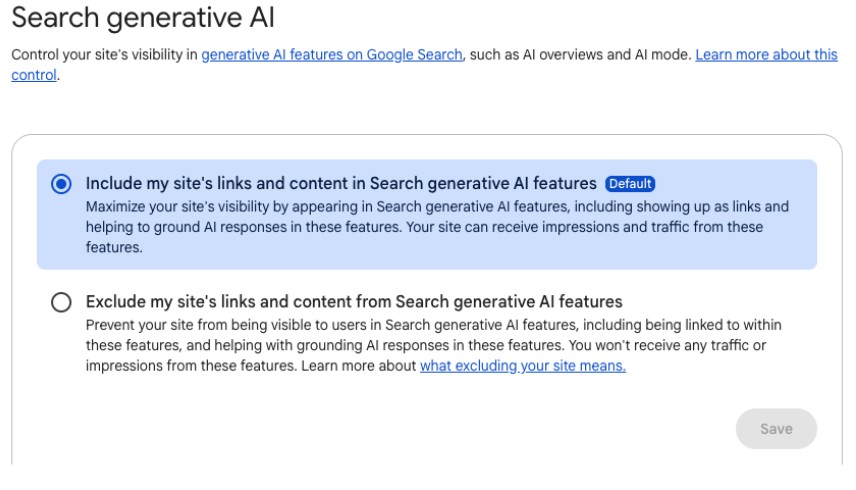
Someone may have changed your default settings in Google Search Console’s AI Control page.
Generative AI Control Settings: How to Fix It
Confirm that the site's Search generative AI control is not set to Exclude. Here is what the settings page looks like:
NoSnippet Tags
The presence of a nosnippet meta tag can keep an entire page from showing up in generative AI answers like Google’s AI Overviews, while a data-nosnippet attribute can keep certain sections of the page from being cited.
Nosnippet tags: How to Fix It
Check for a NoSnippet Meta tag in your HTML. It will appear in the <head> area of the source code. If you find one, remove it. View your source code and look for:
<meta name="robots" content="nosnippet">
Check for a data-nosnippet attribute in the <body> area of the page. If you find one, remove it (unless you really don’t want that section to be excluded from AI Overviews). Here is what to look for in your HTML source code:
data-nosnippet
Lack of Information Gain
The page may not add information that isn’t already available from many other sources, including the large language models (LLM) training data. Many practice area pages fall short of the information gain standards because they are thin and repetitive.
Lack of Information Gain: How to Fix It
Test whether a page offers substantial value compared with others in the AI Overviews. What value does your page provide, that other pages don’t? Often, this could be as simple as a first-person perspective from one of the attorneys.
Doesn’t Answer the Question
The content may not answer what people search, like an Illinois landlord-tenant page that never explains how a Chicago renter gets a security deposit back.
Doesn’t Answer the Question: How to Fix It
Start by creating content around specific legal questions. The Performance report in Search Console shows which queries already bring people to your site. You can use this to help optimize your law firm for Google AI Overviews, but they tend to be “short tail” queries consisting of just a few words. The key is to build on those, by digging deeper into the questions people ask when researching those high-level topics.
Because more people describe their circumstances rather than name a practice area, broad pages should be broken into pages or sections that each answer one question. An Ohio estate firm could split a probate page into "Do I need a lawyer to probate a small estate in Ohio?" and "What does an executor do first?"
Effective legal SEO for AI Overviews leverages query fan-outs, a process where the AI system automatically runs multiple related sub-queries behind a single user question and cites pages across those results. Consequently, answering follow-up questions and procedural details (like filing deadlines) is essential to rank your law firm in Google AI Overviews. Here's a free tool for discovering the fan-out queries for any given search.
Tactical Tip: Look at the end of an AI Overview.
Often, Google asks the searcher a follow-up question. Each of those questions names a detail that changes the right answer: dates, group size, budget, location, income, employment type. If your page gives one generic answer, it may not be answering the question Google thinks the searcher is really asking.
If Google Search Console listgs “Car accident attorneys in {MyCity}” as a query bringing traffic to your site from traditional search, check the bottom of the AI Overview answer for ideas on more specific questions to answer. This is also part of the “information gain” concept we discussed earlier. Look for something like this:
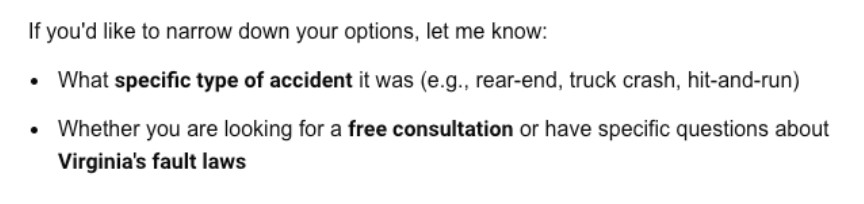
Therefore, if you want your firm to get recommended by Google on this type of search, it would be helpful to discuss specific types of auto accidents, and how they are handled by your firm. It would also be helpful to explicitly state whether you offer free consultations for these situations.
Incomplete, Inconsistent or Inaccurate Firm Information
Your firm's information may be incomplete or inconsistent on your own website and off-site profiles, or there may be inaccurate information about your firm on other websites. For example, there could be an old office address on a business profile, or a lawyer’s bio listing a practice area the firm has dropped. This type of thing can keep your firm from showing up in AI Overviews if the search intent was to find a law firm in a specific location or practice area.
Incomplete, Inconsistent, Inaccurate Information: How to Fix It
An easy way to find these issues is to ask each major AI system to describe what they know about your firm. Go to ChatGPT, Google Search, Gemini, Claude, Microsoft CoPilot and other AI systems, and ask something like: “Tell me what you know about {your law firm} and include the citation source for the information and facts you generate”. Then, if the wrong information comes back, you’ll know where it was found so you can have it fixed.
Google expects a Business Profile to represent the business as it appears in the real world and lists up-to-date profile information among its AI-feature best practices. Keep reputable third-party profiles consistent with your site too, although no single directory or profile determines AI Overview inclusion.
Poorly Formatted Pages, Mixed Topics, and Walls of Text
AI models do not read full pages like humans; they break content into smaller pieces (typically 100 to 300 words or 2 to 4 sentences) that can be used for passage-based retrieval. A page without headings, or long paragraphs that cover multiple topics makes it more difficult for Google’s AI Overviews to quote, or cite, your content.
Poor Formatting and Mixed Topics: How to Fix It
Make your legal information clear and easy to navigate with descriptive headings, direct answers to questions, and a tight scope focusing on specific topics or sub-topics. Break these up into a logical order and include internal links to related pages.
Don’t try to cover more than one aspect of a topic per paragraph. Yes, your middle-school English writing lessons are still helpful when optimizing a legal practice for AI Overviews on Google.
Use the full range of header tags, including H1, H2, H3... to define the hierarchical relationship between topics on a page.
Lack of Perceived Expertise, Authority or Trust (EEAT)
E-E-A-T, Google's framework of experience, expertise, authoritativeness and trustworthiness, shapes its content quality guidance without being a ranking factor itself. Google gives those qualities more weight on topics affecting people's finances or well-being, as most legal questions do.
Lack of EEAT: How to Fix It
Demonstrate relevant legal experience and expertise to establish authority and trust with accurate attorney bios that include credentials and jurisdictions. Link to these bios from any content authored by that expert to show who stands behind the content.
Publish content with other trusted websites and link back to the writer’s profile on your site. A true expert will be trusted by peers, as opposed to just authoring content on your site.
Demonstrate the effort, originality, talent, and skill of the expert writer within the content. Google provides guidelines for these factors.
Above all, make sure the content is accurate. This is hugely important now that so many legal practices rely on AI to generate content for their website. AI systems hallucinate facts often. A legal professional should always write – or at least review – all content published that could be seen as legal information or advice.
How does BestLawyers.com Fit into All of This?
Standard profiles on directory sites like Best Lawyers or Best Law Firms complement these efforts in several ways:
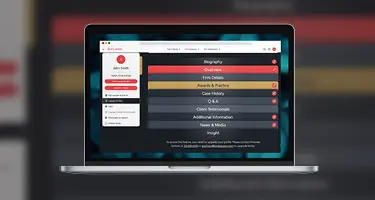
- Best Lawyer profiles provide a place where you have control over the accuracy of information presented about your legal practice. Always keep this up to date. We offer a guide on updating your profile for AI search.
- Recognized lawyers on BestLawyers.com have the option to publish content about legal topics, which helps establish their expertise and experience.
- Being recognized by Best Lawyers is a sign of expertise, authority and trust.
- Even if your own law firm website isn’t cited in Google’s AI Overview, your attorney profile or law firm profile on Best Lawyers and Best Law Firms is the next best thing.
How Can Law Firms Monitor Their AI Overview Visibility?
Choose key queries for your practice areas and track them monthly to see if an AI Overview appears and which sites are cited. You can also review Search Console's Generative AI performance report, launched in August 2026. Note that this tool currently tracks total impressions across AI features without separating clicks or specific queries and it requires a minimum traffic threshold to display data.
Track which pages gain impressions and read those numbers alongside organic traffic and conversions, because an overview can answer a question before anyone clicks. Reassess after each round of content changes.
Frequently Asked Questions
Can I pay to have my law firm appear in Google AI Overviews?
Not as a source. Google Ads can place certain ads above, below or within AI Overviews in the U.S. and some other countries, and no one can buy better placement in Google's organic results.
Does ranking on Google's first page guarantee AI Overview inclusion?
No. Google picks each overview's links and often cites lower-ranked pages.
Does my law firm need special AI optimization software?
No. Google requires no special files, markup or formats for its AI features, though tools can help track queries.
Can smaller law firms appear in Google AI Overviews?
Yes. Google sets no size threshold for eligibility and requires only that a page be indexed and eligible for a snippet.
How long does it take to see results from AI Overview optimization?
There is no set timeline. Crawling a changed page can take a few days to a few weeks, so watch the Generative AI report over time.