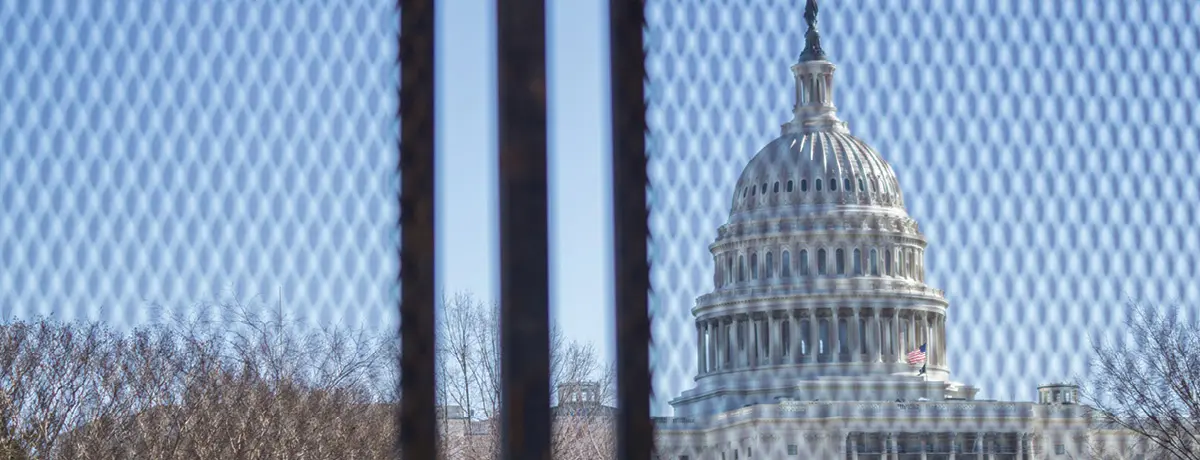

When the National Guard was first deployed in Washington, D.C. in August, 2025, it was never supposed to be a long-term tenant. But this July, the Pentagon confirmed to NPR that the deployment will continue through Inauguration Day 2029 unless the president ends it sooner. That scheduling modifies the original "emergency" framing: by turning a disruption D.C. business could plan around into one they have to build around.
More than 5,000 troops from multiple states were stationed in the city this summer, up from roughly 2,300 at the original deployment, with higher numbers further around July 4th weekend, according to 7News. A Senate Homeland Security and Governmental Affairs Committee report from Democratic staff estimates a cost of $1 million to $1.65 million a day. A Defense Department estimate provided to Congress puts the total cost of the extension at roughly $1.4 billion, according to PBS/AP.
For D.C. lawyers, the number that matters isn't the daily cost, but the year. A "temporary emergency" that runs into 2029 stops being temporary in the documents that businesses sign, the policies they buy, and the compliance protocols they build.
Instead, it becomes a planning variable that firms across at least three practice areas must have sound solutions for.
- D.C.’s National Guard deployment is now scheduled through 2029, forcing businesses and counsel to treat it as a long-term operational issue instead of a temporary disruption.
- Commercial landlords, tenants and insurers are reassessing lease terms, force majeure clauses and business interruption coverage as foot traffic drops and restaurant closures rise.
- Hospitality employers face added pressure from federal I-9 audits tied to increased enforcement activity, with fines reaching thousands of dollars per employee for compliance failures.
- With lawsuits over the deployment still unresolved, this article outlines how D.C. businesses and legal advisers are updating contracts, risk planning and compliance strategies now instead of waiting for the courts.
Why the deployment is still legally unsettled
Lawyers can't give clients a clean answer on the timeline because the legal fight underneath all of this remains unresolved. D.C. Attorney General Brian Schwalb sued the Trump administration in September 2025, arguing the president lacked authority to deploy the National Guard for general law enforcement in the District.
U.S. District Judge Jia Cobb agreed in November, finding the deployment likely violated the D.C. Code's limits on using the Guard for law enforcement without a request from city officials, according to Courthouse News. After the ruling, Schwalb said normalizing the use of military troops for domestic law enforcement "sets a dangerous precedent."
The D.C. Circuit paused that order in December, allowing the deployment to continue while the appeal plays out. Circuit Judges Neomi Rao and Gregory Katsas went further in a concurrence, questioning whether the District has standing to sue the federal government at all as a creation of Congress rather than a sovereign state. ACLU of D.C. Legal Director Scott Michelman later described the arrangement as treating the capital “like a police state,” capturing how differently the deployment reads now than it did as an emergency order.
As of May 2026, the D.C. Circuit was still preparing to hear that merits appeal. A group of 114 U.S. House members filed an amicus brief arguing the deployment violates the Home Rule Act's statutory scheme, the Campaign Legal Center reported.
Commercial Real Estate and Leasing
D.C. real estate attorneys are getting the same question from both landlords and tenants: does the "temporary" language in an existing lease still make sense if the disruption has a scheduled end date three years out?
Force majeure clauses are the obvious starting point, and D.C. courts apply an added layer of scrutiny to them. A Lexology analysis of District law notes that local courts examine whether the disrupting event could have been avoided or anticipated before excusing performance, a standard that gets harder to meet the longer a disruption persists. Hence, a deployment scheduled through 2029 is difficult to characterize as unforeseeable in any lease signed after this summer.
Rent structure is the second pressure point. Retail leases built around percentage rent tied to gross sales assume foot traffic that downtown D.C. hasn't reliably had. Foot traffic across the city dropped sharply during the initial deployment surge, according to retail data cited by CNN. Co-tenancy clauses, which let anchor tenants adjust rent or exit if occupancy or traffic falls below a threshold, are also getting more attention since the surge.
Bean, Kinney & Korman, a firm that regularly advises D.C. metro landlords and tenants, notes that force majeure provisions usually carve out rent obligations specifically. This means that a tenant who can't generate the traffic to hit a co-tenancy threshold often has a stronger practical argument than one hoping to be excused from paying rent outright.
The firm's real estate attorneys caution that local courts "typically enforce the clear and unambiguous terms of a contract," emphasizing why the language matters more than the intent behind it. That distinction is shaping how counsel advises clients on new leases: rather than relying on force majeure language written for hurricanes and pandemics, some are pushing for provisions that name prolonged federal security operations explicitly.
Business Interruption Insurance
Whether a federal law enforcement and military surge counts as a covered peril remains an unsettled question, but it depends heavily on policy language that most hospitality clients haven't reviewed with this scenario in mind.
Standard business interruption policies typically require direct physical loss or damage to trigger coverage, which National Guard deployment doesn't produce on its own. The relevant extension is civil authority coverage, which can apply when a government order restricts access to a business's premises, according to the National Association of Insurance Commissioners, but only if that order follows physical damage to nearby property from a covered peril.
Insurance broker Marsh, writing about the mobilization of Guard troops during the 2025 Los Angeles protests, noted that "the descriptions and triggers of coverage vary under this type of time element extension," with results depending on whether an insured loss has occurred and whether the location falls within the policy's distance limitation. A deployment focused on patrols, checkpoints, and "high-visibility missions" rather than property damage or mandated closures is a difficult fit for that framework.
The business case for pursuing coverage anyway is getting stronger. The Restaurant Association of Metropolitan Washington (RAMW) reported 92 restaurant closures in 2025, a three-year high, tying the increase explicitly to the deployment, a government shutdown, and declining tourism.
The Insurance Information Institute advises businesses to start building a claims file before a loss exists, starting with “locating and organizing records from before the event,” then tracking ongoing income, extra expenses, and correspondence tied to the disruption as it continues. For a deployment with no single triggering incident, that documentation would tie a future civil authority or contingent business interruption claim to a specific order or restriction.
Employment and Immigration Compliance
The deployment's clearest legal exposure for D.C. hospitality employers isn't the troops themselves, but the enforcement activity that’s followed.
Homeland Security Investigations (HSI) sent Notices of Inspection (NOI) to numerous D.C. restaurants, auditing Form I-9 employment eligibility records. The Washington Post reports at least one case when HSI notified a restaurant that 32 of its 46 employees appeared unauthorized to work in the United States. Employers who receive these letters typically have 10 days to terminate flagged employees or provide updated work-authorization paperwork, and failing to act can expose a business to fines ranging from roughly $716 to $5,724 per worker for a first violation, according to Fox News.
Practical exposure compounds quicker for employers with high turnover and inconsistent I-9 recordkeeping, since a single audit can surface documentation gaps across dozens of employees at once. Employment counsel advises D.C. clients to have a rapid-response protocol in place before a notice ever arrives: a designated point of contact authorized to receive HSI paperwork, a process for auditing I-9 files on a rolling basis rather than reactively, and clear internal policy on how managers should respond if agents arrive without a judicial warrant. A NOI alone does not authorize agents to search the premises beyond reviewing the requested records.
While this is distinct from the National Guard litigation, the two are connected in practice. Both stem from the presence of federal authority in the District, requiring D.C. employers to plan for a Guard presence that shapes whether customers show up and an enforcement environment that shapes whether the staff is there to serve them.
Looking ahead
Nothing about the current arrangement is final. The D.C. Circuit's stay paused Judge Cobb's injunction pending appeal, but didn't decide whether the deployment is lawful. A merits ruling could still reshape the legal landscape businesses are now planning around, including whether out-of-state Guard units can be deployed for domestic policing in the District at all.
Meanwhile, local pushback continues: on July 9, all 13 D.C. Council members sent letters to the governors of Michigan and the U.S. Virgin Islands asking them to recall the roughly 240 combined troops those states sent for July 4th security, according to WTOP. Council Chairman Phil Mendelson was blunt about the toll the standoff takes, saying it "hurts our image" and "creates resentment."
The underlying question, of whether the District has any independent standing to challenge federal action within its borders, is the same question behind D.C.'s long-running statehood movement. That fight won't be resolved by this case.
For now, D.C. businesses and the lawyers advising them don't can’t wait for either fight to end. Instead, they have a 2029 date on the calendar and contracts to write around it.