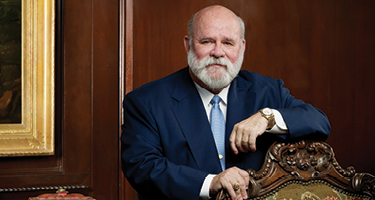

Over the course of more than 45 years in practice, Dan Cogdell has handled some of the country’s highest-profile criminal matters, securing acquittals in cases connected to the Branch Davidian siege and the collapse of Enron and successfully representing Texas Attorney General Ken Paxton, among numerous other significant results.
Now, at 70, the Houston lawyer is looking back on a career that has included more than 300 jury trials in more than 16 states, with no plans to slow down.
“Turning 70 makes you take stock,” Cogdell says. “I’ve had the career I always wanted, and I’m proud of the results we’ve achieved for our clients. But I’m far from finished. The depth of my experience and my knowledge of criminal defense put me in a unique position to help my clients achieve justice.”
- After more than 45 years and 300 jury trials across 16 states, Houston criminal defense lawyer Dan Cogdell reflects on headline-making cases tied to Waco, Enron and Texas Attorney General Ken Paxton while continuing to handle high-stakes litigation.
- The article highlights how preparation, trial experience and strategic case selection shaped acquittals and dismissed charges in some of the country’s most closely watched prosecutions.
- Business leaders, public officials and professionals facing investigations will find insight into how courtroom strategy can influence reputation, career stability and legal outcomes long before trial begins.
- Readers also get a look at how Cogdell’s growing digital presence, including a podcast with more than 400 million views, is expanding his reach beyond the courtroom and creating new opportunities in complex litigation.
Cogdell began his career as a state-court defense attorney, trying everything from traffic tickets to capital murder matters. “In that type of practice, you’re taking on the blood-and-guts cases: murder, robbery, rape, driving while intoxicated,” he recalls. “So, it was common to try a case before a judge who was hostile toward your position. Retrospectively, those experiences were invaluable, albeit occasionally painful at the time.”
After founding Cogdell Law Firm in 1988, Cogdell became increasingly involved in federal litigation. During the savings-and-loan crisis of the late 1980s and early 1990s, he became one of the first lawyers in Texas to successfully defend individuals charged with federal bank or mortgage fraud. In the years since, Cogdell’s practice has focused on health care fraud, securities matters, public corruption, environmental crimes, grand jury investigations and other complex state and federal prosecutions.
A watershed moment in Cogdell’s career came in the mid-1990s, when he represented one of the Branch Davidians prosecuted following the 1993 siege of the group’s compound near Waco, Texas, and secured an acquittal on all charges against him.
“I saw firsthand through the Branch Davidian trial how vital competent criminal defense counsel is to the legal system,” Cogdell says. “That case, perhaps more than any other, demonstrated how important a criminal defense lawyer can be in a situation where the government has run amok.”
Three decades later, Cogdell’s role in the trial was revisited in the five-part series “Waco: The Aftermath,” with actor Giovanni Ribisi portraying him in the courtroom. The series introduced the case to a new audience and gave Cogdell the unusual experience of watching someone else recreate events that had helped define his early career.
“After trying hundreds and hundreds of cases for 40-plus years, I was suddenly an overnight sensation,” he jokes. “I never knew anybody else would want to be me, much less get paid to be me. It was flattering and disconcerting all at the same time.”
Waco was followed by a series of high-profile results. Most notably, Cogdell represented an Enron accountant in the Enron-Merrill Lynch prosecution and secured the sole acquittal in the Enron-related criminal trials. More recently, he helped lead the defense of Texas Attorney General Ken Paxton in his impeachment trial, securing acquittals on all 16 articles considered by the Texas Senate, with four additional articles dismissed. Cogdell also served as lead counsel in Paxton’s long-running state securities-fraud case, which ended with the dismissal of the charges in 2025.
Despite the attention those victories have received, Cogdell maintains that courtroom results are usually determined by the work performed before a jury is selected.
“Trials are not an opportunity for on-the-job training,” he says. “They are a blood sport and need to be viewed as such if you want to succeed for your clients. Experience helps you recognize what matters, but it does not replace preparation. Our opposition might be smarter or younger or have gone to a more prestigious school than us, but they won’t ever outwork us.”
Today, many of Cogdell’s clients are physicians, attorneys, executives and public officials whose careers and reputations are threatened by an investigation or prosecution. He is also increasingly brought into significant civil disputes by lawyers who believe his courtroom knowledge can shape the outcome. Having earned the ability to choose his matters carefully, Cogdell takes on fewer cases and devotes more of his time to each one.
“The longer I do this, the more selective I have become,” he says. “I want to have enough time and enough live ammunition in my chamber to handle cases the right way and get my clients the results they deserve.”
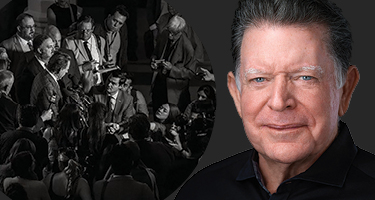
That selectivity has coincided with an unexpected expansion of Cogdell’s public profile. In 2025, he launched Cogdell Law Uncensored, a podcast and social media platform that, in a little over a year, has generated more than 400 million views across digital channels and is now closing in on a combined 1 million followers on Instagram, TikTok and Facebook. In the process, it has led to speaking invitations and multiple civil case opportunities that Cogdell might not otherwise have received.
“I am honestly shocked by the positive responses that our podcast has had. I never could have imagined the success we would have with it after only a little more than a year. There isn’t a day that passes without a few people stopping me on the street and telling me how much they enjoy it. It’s been crazy.”
“Criminal defense remains at the center of my work,” Cogdell notes. “But looking forward, I’m open to new types of cases and new ways to use the judgment I’ve developed through decades in the courtroom. I’m not done yet.”