
Insight

Chain Migration Solutions Desperately in Search of a Problem

The White House insists that any new law giving Dreamers a permanent place in the United States also stop what it refers to as the chain migration problem.

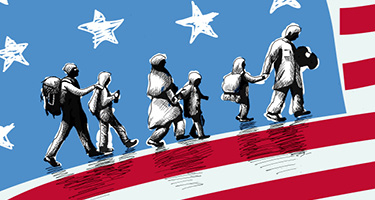
Family with red and blue background with six stick figures
Aaron C. Hall

Aaron C. Hall

February 16, 2018 12:18 PM

If a U.S. citizen decides to invite her aging parents to move into the family home, should the ability to do so depend on whether she is a naturalized citizen with parents who are abroad? The answer will come from Congress as it attempts to reform immigration laws in connection with the raging debate about how to permanently legalize the Dreamer beneficiaries of the Deferred Action for Childhood Arrivals (DACA) program.

The White House insists that any new law giving Dreamers a permanent place in the United States also stop what it refers to as the chain migration problem.

What exactly the problem is, however, is left unstated.

Current law provides for two broad categories of family-based immigration petitions. The first, immediate relatives, consists of spouses, minor children, and parents of adult U.S. citizens. These relatives can immigrate to the United States and become lawful permanent residents as soon as the relevant agencies process the paperwork and confirm that the intending immigrant is eligible and will not become a public charge.

The second category, preference relatives, consists of adult sons, daughters, and siblings of adult U.S. citizens as well as spouses, minor children, and unmarried adult children of lawful permanent residents. Due to statutory caps on the numbers of preference category relatives who can immigrate each year, these visa petitions are subject to lengthy backlogs. As an example, a U.S. citizen’s sibling from Mexico can expect to wait over two decades before he or she can immigrate to the U.S. The adult child of a U.S. citizen can expect to wait over 20 years as well. Current law does not provide any visa category for cousins, aunts and uncles, or grandparents.

The evils of current family-based immigration policy are far from self-evident. The foreign-born share of the U.S. population was 12.9 percent as of the 2010 census, in line with historic norms.

Despite portrayals to the contrary, diversity and family-sponsored immigrants are generally better educated than native-born Americans and are 62 percent more likely to have graduated college.

Study after study shows that immigrants are less likely to commit serious crimes than those who are native-born. Meanwhile, the United States has an aging population and continues to see record-low fertility rates. Our economy and essential programs like Social Security and Medicare need more people of working age. Immigrants with support networks in the form of close family connections are often best situated to thrive. The hard-fought contributions of immigrants, their children, and their children’s children have forever been a driving force behind this country’s success.

But looking only at the direct contributions of family-based immigrants undervalues the benefit of the current policy. Our universities draw some of the brightest minds from all over the world. Generous family immigration policies encourage these highly talented individuals to put down roots in the United States with the understanding that parents and other family members will someday be able to join them here if they choose.

Now the White House proposes eliminating all family-based immigration except for spouses and minor children. Taken together with its other proposals, this would cut legal immigration by 50 percent.

The Immigration and Nationality Act of 1965, which first established our immigration system’s family-based categories, is not sacrosanct. Legitimate debate about which people and which family members of U.S. citizens and residents should be allowed to immigrate to the United States should be encouraged. But useful debate on changes to our laws must be informed by an understanding of how the current system works and should articulate a problem that suggested reforms are aimed at solving. To this point, despite demands and proposals to fix chain migration, there’s been no coherent explanation of a problem.

Without this explanation, we should reject radical changes that will stop U.S. citizens from bringing family members, such as aging parents, to live with them and upend a system that has seen generations of immigrants and their descendants powering our country’s character, culture, and economy.

-------------------------

Aaron Hall is a partner at Joseph Law Firm in Aurora, Colorado. His practice focuses on removal defense, immigration consequences of criminal convictions, family-based immigration, and naturalization. He currently serves on the American Immigration Lawyers Association (AILA) ICE Liaison Committee and frequently presents on immigration law around the country.

Visit the Best Lawyers Find a Lawyer page to connect with immigration attorneys experienced in family‑based petitions and related matters.


Lawyers in Columbus, Ohio

Related Articles

Can a Green Card Be Revoked?


by Bryan Driscoll

Revocation requires a legal basis, notice and the chance to respond before status can be taken away.

Close-up of a U.S. Permanent Resident Card showing the text 'PERMANENT RESIDENT'

The New Business Immigration Regime


by Corporate Immigration Partners

Five things executives and HR should do.

Red and white stripes on the side of a building with black dots on the building

Trump Administration’s Termination of DACA, TPS, and H-4 EAD Immigration Programs Could Leave Employers in a Lurch


by Ann Massey Badmus

Several immigration programs that have authorized over a million immigrant workers are expected to end in 2018 and 2019.

Silhouettes of people on a white background with a blue global map of the world

Smart Policy and Compassion: Protecting Dreamers


by David P. Berry

Why it makes sense to protect the Dreamers.

Silhouette of the Statue of Liberty with the American flag flying high in the background

Trends in EB1 Self-Sponsored Extraordinary Ability Permanent Residence Cases for Researchers


by Douglas J. Halpert

Both the “mirror test” and the USCIS regulatory standard impose exacting standards subject to interpretation.

Multiple snow whites with yellow skirt and blue top with red bow

Trump and Immigration: Separating Truth from Fiction


by Harlan G. York

Deportations aren’t up, but the people who are being deported are more “newsworthy.”

American flag with a blue spotlight and a black background with a black wire fence in front of it

Is Time Running Out for DC’s Sanctuary City Law?


by Bryan Driscoll

The Capitol is battling the White House in a dangerous game.

DC sanctuary city law headline

IN PARTNERSHIP

Immigration Pathways in the United States


by Versfeld & Hugo

Leon Versfeld knows firsthand how challenging obtaining a visa can be. Whether your path to residency involves investments, employment or athletic accolades, Versfeld & Hugo will guide you through every step.

United States passport with social security card and hundreds of dollars fanned out

How US Immigration Works: Everything You Need to Know


by Jennifer Verta

Explore the pathways, processes and evolving policies shaping U.S. immigration today.

Illustration of Immigrant Family Journey in Front of American Flag

Announcing the 2024 Best Lawyers Immigration Law Legal Guide


by Best Lawyers

The first edition of the Best Lawyers Immigration Law Legal Guide for 2024 is now live and includes recognitions for all Best Lawyers immigration law awards.

American flag waving over shadows of people

IN PARTNERSHIP

Gonzalez Olivieri, LLC: An Immigration Firm You Can Trust


by Gonzalez Olivieri

Gonzalez Olivieri, LC has years of experience in immigration law specializing in helping businesses and families in Texas through complex legal proceedings.

A White Hand Holding a Stamp Above Papers on a Clipboard in Front of a Laptop

Domestic Visa Renewal


by Tiffany Derentz

Domestic visa renewal is a game-changer, but it will take time and resources.

Man sitting on paper airplane connected to a start button being pressed by hand

I-140 Petition


by Vivien Li and Elizabeth L.A. Garvish

I-140 petition requires financial ability to pay for small business, sole proprietor, household and other individual petitioners.

I-140 paper forms and money

Waiver Programs for International Medical Graduates


by Elizabeth L.A. Garvish

Immigration lawyer Elizabeth L.A. Garvish offers an overview of the interested government agency waiver programs for international medical graduates.

People forming a circle with white cross in center

IN PARTNERSHIP

Jan Pederson’s Immigration Career


by Wright, Constable & Skeen

Jan Pederson is an immigration law lawyer and partner at Wright, Constable & Skeen, where she has built a strong career working to obtain the best results for her clients.

Clock over image of person typing on computer

Changes to the New Form I-9 and Verification Process


by Nia Doaks

Best Lawyers: Ones to Watch® in America honoree Nia Doaks of Constangy, Brooks, Smith & Prophete offers guidance in navigating new Form I-9 changes.

I-9 Immigration Form with pen

Trending Articles

How to Sue for Defamation: Costs, Process and What to Expect


by Bryan Driscoll

Learn the legal standards, costs and steps involved when you sue for defamation, including the difference between libel and slander.

Group of people holding papers with speech bubbles above them

The Family Law Loophole That Lets Sex Offenders Parent Kids


by Bryan Driscoll

Is the state's surrogacy framework putting children at risk?

family law surrogacy adoption headline

Best Lawyers 2026: Discover the Honorees in Brazil, Mexico, Portugal, South Africa and Spain


by Jamilla Tabbara

A growing international network of recognized legal professionals.

Map highlighting the 2026 Best Lawyers honorees across Brazil, Mexico, Portugal, South Africa and Sp

Algorithmic Exclusion


by Bryan Driscoll

The Workday lawsuit and the future of AI in hiring.

Workday Lawsuit and the Future of AI in Hiring headline

Unenforceable HOA Rules: What Homeowners Can Do About Illegal HOA Actions


by Bryan Driscoll

Not every HOA rule is legal. Learn how to recognize and fight unenforceable HOA rules that overstep the law.

Wooden model houses connected together representing homeowners associations

Holiday Pay Explained: Federal Rules and Employer Policies


by Bryan Driscoll

Understand how paid holidays work, when employers must follow their policies and when legal guidance may be necessary.

Stack of money wrapped in a festive bow, symbolizing holiday pay

Reddit’s Lawsuit Could Change How Much AI Knows About You


by Justin Smulison

Big AI is battling for its future—your data’s at stake.

Reddit Anthropic Lawsuit headline

US Tariff Uncertainty Throws Canada Into Legal Purgatory


by Bryan Driscoll

The message is clear: There is no returning to pre-2025 normalcy.

US Tariff Uncertainty Throws Canada Into Legal Purgatory headline

Florida Rewrites the Rules on Housing


by Laurie Villanueva

Whether locals like it or not.

Florida Rewrites the Rules on Housing headline

The 2026 Best Lawyers Awards in Chile, Colombia and Puerto Rico


by Jamilla Tabbara

The region’s most highly regarded lawyers.

Map highlighting Chile, Colombia and Puerto Rico for the 2026 Best Lawyers Awards

UnitedHealth's Twin Legal Storms


by Bryan Driscoll

ERISA failures and shareholder fallout in the wake of a CEO’s death.

United healthcare legal storm ceo murder headline

Alimony Explained: Who Qualifies, How It Works and What to Expect


by Bryan Driscoll

A practical guide to understanding alimony, from eligibility to enforcement, for anyone navigating divorce

two figures standing on stacks of coins

Can a Green Card Be Revoked?


by Bryan Driscoll

Revocation requires a legal basis, notice and the chance to respond before status can be taken away.

Close-up of a U.S. Permanent Resident Card showing the text 'PERMANENT RESIDENT'

New Texas Family Laws Transform Navigating Divorce, Custody


by Bryan Driscoll

Reforms are sweeping, philosophically distinct and designed to change the way families operate.

definition of family headline

Why Skechers' $9.4B Private Equity Buyout Sparked Investor Revolt


by Laurie Villanueva

Shareholder anger, a lack of transparency and a 'surprising' valuation.

Skechers shareholder lawsuit headline

What Is the Difference Between a Will and a Living Trust?


by Bryan Driscoll

A practical guide to wills, living trusts and how to choose the right plan for your estate.

Organized folders labeled “Wills” and “Trusts” representing estate planning documents