Insight

The Grave Reality

As Canada awakens to the unmarked graves of more than a thousand Indigenous children, lawyers and the Canadian government begin to carve out restitution and a path forward.

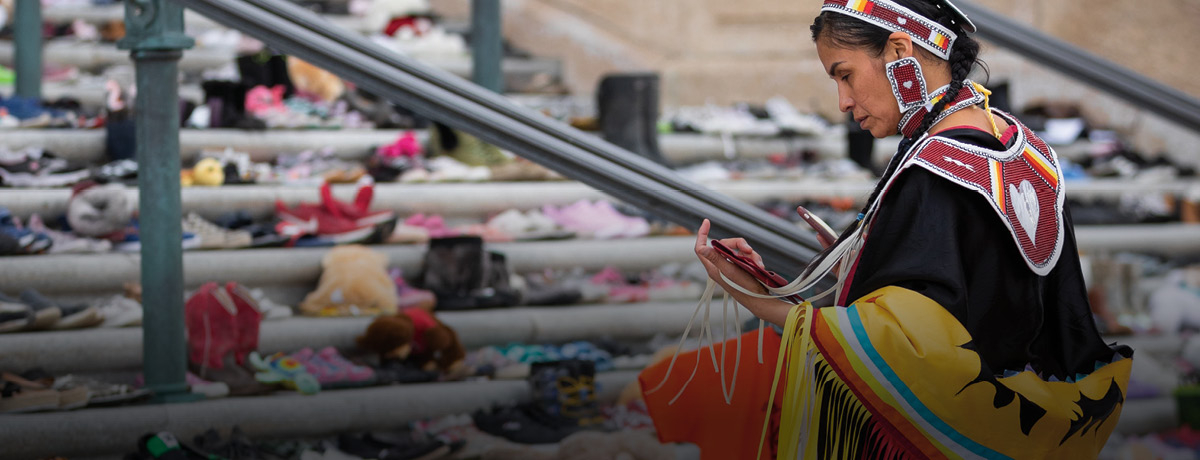
Indigenous woman stands near piles of children's shoes
SC

Sara Collin

December 10, 2021 06:05 AM

“If it was a shock, then they haven't been awake.”

Over 1,000 Unmarked Graves Uncovered in 2021

On May 28, 2021, it was announced that 215 unmarked burials of Indigenous children had been uncovered near the site of a former residential school in Kamloops, British Columbia. The news made national and international headlines and many people took to social media to express their shock, outrage, sorrow and solidarity.

When over 1,000 additional unmarked graves were discovered over the next two months, the public and governmental response grew and reached a symbolic crescendo. The Canadian government passed legislation declaring September 30 the National Day for Truth and Reconciliation and a statutory holiday, flags were lowered to half-mast and people gathered around the country, wearing orange shirts as a symbol of solidarity for truth and reconciliation.

What Canada Already Knew About Residential Schools

However, to many, these discoveries did not quite come as a shock.

As noted in the above quote by Allan Donovan, a lawyer at First Peoples Law in Vancouver with three decades of experience practising Aboriginal law and representing First Nations, the existence of these graves was no secret to those working in the field.

Referring to the 2015 Truth and Reconciliation Commission report, which identified the existence of thousands of confirmed deaths of both named and unnamed residential school children, Donovan said, “So everyone knew about this, and anyone who wanted to know who had access to the internet, or talked to Indigenous people, they would know.”

In fact, the first discovery of a residential school gravesite in Canada dates as far back as the 1970s, and the current count of uncovered graves stands at approximately 1,874, with many more speculated to exist.

The Cultural Genocide of the Residential School System

The residential school system was composed of a network of so-called boarding schools run by the Canadian government and administered mainly by Catholic, Anglican and United churches between 1879 and 1997. The system was intended to remove and isolate Indigenous children from their culture, language, families and communities under the guise of assimilating them into “Canadian culture”.

In reality, the children were subjected to abominable living conditions and systemic abuse, including sexual, physical and psychological abuse. Over the course of the system’s existence, approximately 150,000 children were placed in residential schools nationally and it is estimated that the number of school-related deaths range from 3,200 to upwards of 6,000, although the exact number remains unknown due to an incomplete historical record.

The Truth and Reconciliation Commission called the residential school system “cultural genocide”.

Breaking the Silence on Residential School Abuse

For Nadir André*, a partner at Borden Ladner Gervais LLP in Montreal with over 23 years’ experience specializing in Indigenous law, and a member of the Matimekush-Lac John First Nation, knowledge of the residential school system and its crimes was born out of a more personal connection. His father was a survivor of the residential school system and sexual abuse.

However, André shared that his father never spoke of his experience and André only learned of his abuse shortly after becoming a lawyer, when he accompanied his father to court one day. Believing himself to be joining his father to only watch the trial of a residential school system abuser, André was shocked when his father was called to the stand to testify – it was his father’s abuser.

“I have to admire the resilience, because it must have been a horrible experience as a child, horrible,” André reflected. “Because he, I guess, he had a really bad time there in a residential school, but never did he mention it. And the fact that he managed to get a university diploma, and become a teacher, and have a good life, travel all over the world, and be able to feed his family and everything … I have to admire what he's done, and how he managed to live with the secret.”

Breaking this silence and giving survivors a voice and an opportunity to share their experiences was one of the purposes of the Truth and Reconciliation Commission. The Commission heard survivors’ stories from across the country between 2008 and 2015. The resulting report contained 94 calls to action regarding reconciliation between Canadians and Indigenous peoples.

The CBC website Beyond 94 currently reports that of the 94 calls to action, only 13 have been completed.

Legal Paths Moving Forward

Over the years, thousands of individual legal claims have been filed and at least one notable settlement with the Canadian government has been reached. In 2007, the Indian Residential Schools Settlement Agreement was approved between the Federal government and Indigenous peoples who attended the schools. The agreement helped establish the Truth and Reconciliation Commission. It has also paid out over $4 billion to survivors so far.

As to whether the discovery of the most recent gravesites will lead to additional compensation or civil claims, neither André nor Donovan would speculate on specifics, other than to say that it was possible.

However, André also raised the issue of future criminal investigations, stating, “Some are asking for the International Criminal Court to investigate because it could fit under war crimes and genocide. In the Truth and Reconciliation Commission, they talked about cultural genocide. And then in the commission that followed on the death and disappearance of Aboriginal women, we're talking about genocide. So for some organizations and some lawyers, well, if it's a genocide, regardless if it's cultural or not, there should be an independent international investigation. And I know for a fact that there have been requests made to investigate.”

The Road to Reconciliation

As to reconciliation moving forward, Donovan submitted that the Canadian government begin addressing issues of restitution by identifying and dealing with the broad range of problems caused by residential schools and stop acting as an adversary to First Nations. Observing that the echoes of the violence and abuse from the residential school system continue to reverberate through Indigenous communities, Donovan stated that the resulting intergenerational trauma has not been adequately addressed. Finally, referencing Canada’s recent adoption of the United Nations Declaration on the Rights of Indigenous People (UNDRIP) in 2021, Donovan remarked, “You don’t need an international declaration to permit Canada to do the right thing.”

To André, reconciliation would first involve acknowledging Aboriginal and Indigenous people as sovereign people and addressing matters of self-determination and self-governance. It would require a new land regime that would allow communities to have a say in land ownership and management. In addition, laws would have to be changed to clarify jurisdictional and governance matters. André concluded by stating, “Apologies are symbolically important, but what needs to change is the empowerment of the peoples to take their lives back and to take control of the land they live on.”

Both André and Donovan acknowledge that reconciliation will take time, regardless of the path, with Donovan noting, “It's just painfully slow.”

Sara Collin is a Quebec-based lawyer, specializing in legal writing, editing, research and translation throughout Canada.

Allan Donovan has been listed in The Best Lawyers in Canada™ since 2006 in Indigenous and First Nations Practice.
Nadir André has been listed in The Best Lawyers in Canada™ since 2009 Indigenous and First Nations Practice.
*Disclaimer: Quotes and commentary from Nadir André are expressly his own and do not reflect those of BLG.

Headline Image: Unsplash/TandemXVisuals

Related Articles

Unenforceable HOA Rules: What Homeowners Can Do About Illegal HOA Actions


by Bryan Driscoll

Not every HOA rule is legal. Learn how to recognize and fight unenforceable HOA rules that overstep the law.

Wooden model houses connected together representing homeowners associations

What Is the Difference Between a Will and a Living Trust?


by Bryan Driscoll

A practical guide to wills, living trusts and how to choose the right plan for your estate.

Organized folders labeled “Wills” and “Trusts” representing estate planning documents

Do You Need a Real Estate Attorney to Refinance?


by Bryan Driscoll

When and why to hire a real estate attorney for refinancing.

A couple sitting with a real estate attorney reviewing documents for refinancing their mortgage

How to Get a Power of Attorney


by Bryan Driscoll

Learn the steps to set up a power of attorney, the risks of DIY forms and how to choose the right person to act on your behalf.

A couple discussing power of attorney paperwork with a lawyer

IN PARTNERSHIP

Breaking Down Criminal Conviction in Canada


by Mass Tsang

Statistics Canada’s annual breakdown of adult criminal court data provides an eye-opening review of how the country’s court system resolves its hundreds of thousands of cases annually.

Silhouettes of Officer walking with two men on a strip of concert

IN PARTNERSHIP

Things to Consider When Choosing a Sexual Assault Lawyer in Ontario


by Igor Vilkhov

Choosing the right lawyer when faced with sexual assault charges is important. Here are a few things to consider.

Vilkhov Law attorney sits in the dark with a black and white filter

Alimony Explained: Who Qualifies, How It Works and What to Expect


by Bryan Driscoll

A practical guide to understanding alimony, from eligibility to enforcement, for anyone navigating divorce

two figures standing on stacks of coins

Should I Get a Prenup? A Guide for Couples


by Bryan Driscoll

Prenuptial agreements aren’t just for the wealthy. Here’s what they do, when you might need one and how to decide if it’s right for your relationship.

Prenuptial agreement with pen

How to Sue for Defamation: Costs, Process and What to Expect


by Bryan Driscoll

Learn the legal standards, costs and steps involved when you sue for defamation, including the difference between libel and slander.

Group of people holding papers with speech bubbles above them

How to Get a Patent


by Bryan Driscoll

A comprehensive guide to understanding patents, the application process and strategies to protect your invention in the U.S.

Illustration of a person with an idea next to a lawyer holding patent documents

How to Choose a Good Lawyer: Tips, Traits and Questions to Ask


by Laurie Villanueva

A Practical Guide for Your First-Time Hiring a Lawyer

Three professional lawyers walking together and discussing work

How Best Lawyers Connects You With Trusted Legal Counsel


by Jennifer Verta

Discover how Best Lawyers simplifies the attorney search process.

A focused woman with dark hair wearing a green top and beige blazer, working on a tablet in a dimly

Inflation Escalation


by Ashley S. Wagner

Inflation and rising costs are at the forefront of everyone’s mind. The current volatile market makes it more important than ever to understand the rent escalation clauses in current and future commercial lease agreements.

Suited figure in front of rising market and inflated balloon

IN PARTNERSHIP

Coffey Burlington's Legal Expertise


by John Fields

Service. Integrity. Results.

Coffey Burlington 2025

IN PARTNERSHIP

Elevating Our Cases Into Causes


by Justin Smulison

Two female attorneys

IN PARTNERSHIP

Federal Employee Advice: I’ve Been RIF’d. Now What?


by Bernabei & Kabat

What to do after a Reduction in Force

Two toy people being held in the palm of someone's hand above a group of other toy people

Trending Articles

2026 Best Lawyers Awards: Recognizing Legal Talent Across the United States


by Jamilla Tabbara

The 2026 editions highlight the top 5% of U.S. attorneys, showcase emerging practice areas and reveal trends shaping the nation’s legal profession.

Map of the United States represented in The Best Lawyers in America 2026 awards

Gun Rights for Convicted Felons? The DOJ Says It's Time.


by Bryan Driscoll

It's more than an administrative reopening of a long-dormant issue; it's a test of how the law reconciles the right to bear arms with protecting the public.

Firearms application behind jail bars

2026 Best Lawyers Awards in Canada: Marking 20 Years of Excellence


by Jamilla Tabbara

Honoring Canada’s most respected lawyers and spotlighting the next generation shaping the future of law.

Shining Canadian map marking the 2026 Best Lawyers awards coverage

Revealing the 2026 Best Lawyers Awards in Germany, France, Switzerland and Austria


by Jamilla Tabbara

These honors underscore the reach of the Best Lawyers network and its focus on top legal talent.

map of Germany, France, Switzerland and Austria

Best Lawyers 2026: Discover the Honorees in Brazil, Mexico, Portugal, South Africa and Spain


by Jamilla Tabbara

A growing international network of recognized legal professionals.

Map highlighting the 2026 Best Lawyers honorees across Brazil, Mexico, Portugal, South Africa and Sp

How to Sue for Defamation: Costs, Process and What to Expect


by Bryan Driscoll

Learn the legal standards, costs and steps involved when you sue for defamation, including the difference between libel and slander.

Group of people holding papers with speech bubbles above them

Build Your Legal Practice with Effective Online Networking


by Jamilla Tabbara

How thoughtful online networking supports sustained legal practice growth.

Abstract web of connected figures symbolizing online networking among legal professionals

Algorithmic Exclusion


by Bryan Driscoll

The Workday lawsuit and the future of AI in hiring.

Workday Lawsuit and the Future of AI in Hiring headline

Blogging for Law Firms: Turning Content into Client Connections


by Jamilla Tabbara

How law firms use blogs to earn trust and win clients.

Lawyer typing blog content on laptop in office

Reddit’s Lawsuit Could Change How Much AI Knows About You


by Justin Smulison

Big AI is battling for its future—your data’s at stake.

Reddit Anthropic Lawsuit headline

How to Choose a Good Lawyer: Tips, Traits and Questions to Ask


by Laurie Villanueva

A Practical Guide for Your First-Time Hiring a Lawyer

Three professional lawyers walking together and discussing work

The 2026 Best Lawyers Awards in Chile, Colombia and Puerto Rico


by Jamilla Tabbara

The region’s most highly regarded lawyers.

Map highlighting Chile, Colombia and Puerto Rico for the 2026 Best Lawyers Awards

Common-Law Marriage in Indiana: Are You Legally Protected?


by Laurie Villanueva

Understanding cohabitation rights and common-law marriage recognition in Indiana.

Married Indiana couple in their home

Why Jack Dorsey and Elon Musk Want to 'Delete All IP Law'


by Bryan Driscoll

This Isn’t Just a Debate Over How to Pay Creators. It’s a Direct Challenge to Legal Infrastructure.

Elon Musk and Jack Dorsey standing together Infront of the X logo

AI Tools for Lawyers: How Smithy AI Solves Key Challenges


by Jamilla Tabbara

Understand the features and benefits within the Best Lawyers Digital Marketing Platform.

Legal professional editing profile content with Smithy AI

Alimony Explained: Who Qualifies, How It Works and What to Expect


by Bryan Driscoll

A practical guide to understanding alimony, from eligibility to enforcement, for anyone navigating divorce

two figures standing on stacks of coins