

At the 2026 Legal Marketing Association (LMA) Annual Conference in New Orleans, Best Lawyers introduced a new way to access its trusted legal rankings: a dedicated application within ChatGPT.
The launch reflects a broader shift in how people search for and evaluate legal services. Increasingly, the starting point is no longer a list of links, but a question. People are turning to AI-powered platforms to ask, refine and rethink what they need in real time.
For the legal industry, that shift carries weight. The question is no longer just how to be found, but how to be trusted in an environment where answers are generated, not simply displayed. As more decisions begin inside these systems, ensuring that those answers are accurate, credible and grounded in real expertise becomes essential.
The Best Lawyers ChatGPT app is designed to address exactly that.
- Best Lawyers unveiled a ChatGPT app at the 2026 LMA conference, reflecting a shift in legal search.
- Users ask natural questions and receive attorney results shaped by four decades of peer review data.
- For law firm marketing and leadership teams, visibility increasingly depends on appearing inside AI generated answers.
- The launch signals urgency for firms to structure credible public data as clients begin research in AI tools.
Bringing Peer-Reviewed Legal Insight Into AI Conversations
For more than four decades, Best Lawyers has relied on a simple but rigorous principle: lawyers are best positioned to evaluate the work of other lawyers. That peer review process has long served as a trusted benchmark for identifying legal excellence.
With the introduction of our ChatGPT app, that same foundation now extends into a very different kind of environment.
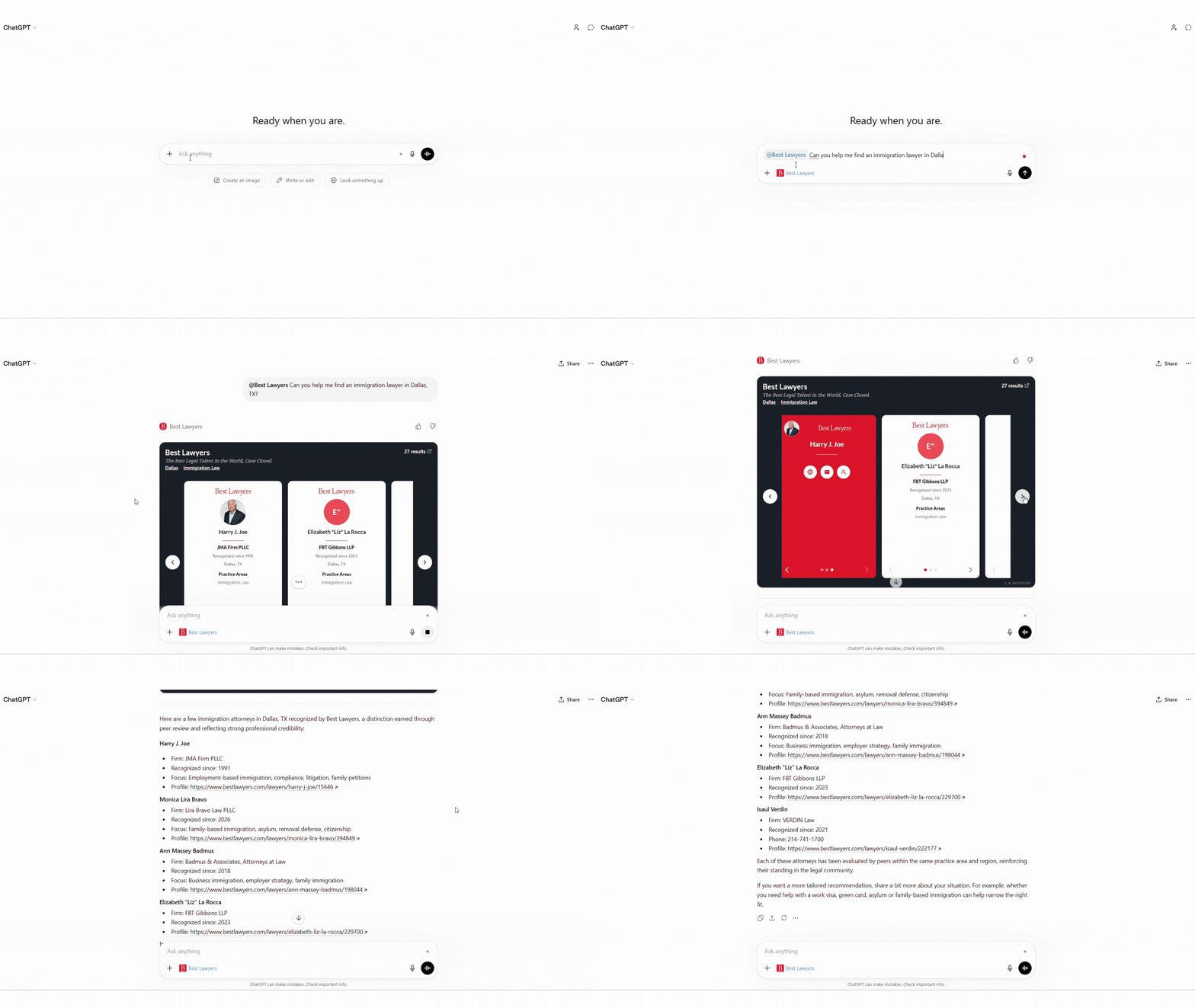
Once connected to the Best Lawyers app within ChatGPT, users can search for attorneys in a way that feels natural and immediate. A question such as “Find me a corporate lawyer in Chicago” becomes the starting point. From there, results are shaped by Best Lawyers’ peer-reviewed data, offering recommendations that reflect both practice area and location.
The experience is intentionally straightforward, but its implications are broader. It shortens the distance between a question and a credible answer. Instead of navigating multiple websites and comparing fragmented information, users are guided toward vetted professionals within a single interaction.
That interaction is not limited to one type of user. A prospective client looking for representation, a lawyer seeking a trusted referral, or in-house counsel working through a complex issue all approach the same problem from different angles. The app is designed to support each of them, without requiring them to change how they ask the question.
A Changing Landscape for Legal Discovery
In this environment, visibility takes on a different meaning. It is no longer defined by position on a results page, but by whether a source is recognized and used when answers are generated.
For legal services, where decisions carry significant weight, the quality of those sources matters. Reliable, well-structured and carefully vetted information becomes essential to ensuring that recommendations are not only relevant, but responsible.
Extending Best Lawyers into ChatGPT ensures that peer-reviewed legal insight remains part of that process, even as the format of discovery continues to evolve.
Innovation With Accountability
Advancing into AI-driven environments brings a new set of expectations. In law, those expectations are closely tied to trust. However, the introduction of new technology does not remove the need for judgment. It increases it.
As a company, we are focusing on accountability. AI is not treated as a system operating independently of oversight, but as a tool guided by human judgment and informed by structured, peer-reviewed data.
Clear boundaries remain in place. Private information is not exposed. Public data is organized in ways that allow it to be interpreted accurately. The goal is to ensure that ease of access does not come at the expense of reliability.
This reflects a broader view of innovation. It is not only about what it can build, but about what should be built and how it should be used.
Built on a Broader Strategy of Innovation
The Best Lawyers ChatGPT app is one expression of a broader effort across the organization to adapt to a changing landscape.
That effort reflects a wider examination of how lawyers, clients and institutions interact with information and how those interactions continue to evolve.
Smithy AI
This approach can also be seen in an earlier introduction: Smithy AI, a proprietary tool developed to support how lawyers and law firms present themselves and their expertise in a digital environment.
While its initial use focused on enhancing profiles and content, its capabilities continue to evolve as new applications are explored across the platform. Like the ChatGPT app, it reflects an ongoing effort to build tools that adapt alongside changing technology and user behavior, rather than remaining fixed at a single point in time.
Across the organization, teams are engaging with emerging technologies, testing new approaches and refining how information is created and delivered. This work is guided by a shared objective: improving how people connect with the legal expertise they need.
Progress, in this context, is not defined by speed alone, but by whether the outcome is more useful, more accessible and more aligned with how decisions are actually made.
Leadership Shaped by Technical Expertise
That perspective is reinforced by leadership with direct experience in building technology.
Best Lawyers CEO Phillip Greer began his career as a software engineer and has been closely involved in the company’s evolution from an analog process to a digital platform. That experience continues to shape how new technologies, including AI, are approached.
Decisions are grounded in an understanding of both possibility and practicality. Ideas are evaluated not only for their potential impact, but for how they function in real-world scenarios. This creates continuity between strategy and execution and reinforces a culture where innovation is something to be built, tested and improved over time.
Expanding Access to Trusted Legal Information
The introduction of the ChatGPT app represents a continuation of that approach.
As more people turn to AI as a starting point for research, the need for credible, well-sourced legal information becomes more pronounced. The app extends that ability, placing peer-reviewed legal insight within a format that reflects how users are already seeking answers.
The underlying objective remains consistent. It is not tied to a single platform, but to a broader responsibility: helping people find trusted legal expertise with clarity and confidence.
As the ways in which questions are asked continue to change, the importance of providing reliable answers does not.
Connect your account with the Best Lawyers ChatGPT App and find the best peer-reviewed lawyer for your needs.