Law firm marketing has followed a reliable formula for many years: dominate search results with keyword-rich content on "What is Medical Malpractice?" or "Steps in a California Divorce," then juice up rankings through aggressive link-building and watch qualified traffic flow to your site.
- AI is transforming law firm marketing by providing direct answers in search results, causing traditional blog traffic to decline. Legal marketers must adapt strategies to leverage directories like Best Lawyers for AI-based search visibility.
- While AI addresses top-of-funnel queries, focus on strengthening bottom-of-funnel content such as case studies, client reviews and outcomes that prove capability and peer validation.
- Optimize Best Lawyers profiles with unique, detailed information to enhance credibility and ensure visibility in AI search results, avoiding duplicate content found elsewhere.
- Peer-validated signals and directories are now key in driving law firm success amid AI's rise. Take advantage of this shift to boost credibility and attract clients searching for verified expertise.
But the digital landscape has undergone a revolution. AI-powered search engines and assistants now bypass websites entirely, delivering synthesized answers directly on the search results page. Informational blog posts that once drove leads are hemorrhaging traffic.
Why Top-of-Funnel Traffic Is Under Pressure
When AI provides the answer, the incentive to click through drops. The effects:
- Reduced click-through on explainers. Answers to jurisdictional or definitional questions now appear in the results.
- Less serendipitous discovery. Educational hubs once pulled users deeper into a site; now the session often ends in search.
- Commoditization of look-alike content. With AI distilling common knowledge, only uniquely authoritative sources stand out.
Educational content still supports brand and long-term authority, but it’s less likely to be a primary traffic or lead driver.
The Death of the Informational Traffic Engine
Google’s AI Overviews, as well as ChatGPT and advanced AI assistants, have fundamentally reshaped how users search for and interact with information online.
Search engines don’t just find answers now. They become the answer. When a potential client Googles "Can I sue my landlord for not fixing the roof in Chicago?", they now receive a concise, AI-generated summary with cited sources - all before seeing a single blue link halfway down the page. Users get answers instantly. This is why organic traffic to informational pages has plummeted.
The era of informational content powering lead flow is over. However, you can turn this into an opportunity with the right strategy.
Transaction-Oriented Content Gains Value
By vacuuming up top-of-funnel informational queries (e.g. "What is a wrongful death claim?"), AI has amplified the critical importance of bottom-of-funnel transactional intent content, like:
- Best medical malpractice attorney near me with $10M+ verdicts
- Smith & Jones Massachusetts lawsuit outcomes
- Real customer reviews for Smith & Jones Medical Malpractice Firm
- I’m thinking about hiring Jenna Smith for my premises liability lawsuit in Nevada. Has she won any cases recently? What are some of her highest settlement amounts?
- Show me the best maritime lawyers in Miami, Florida
- You can find them here, by the way.
- Case studies & matter narratives (e.g., “How we secured a $50M verdict in a securities-fraud case”).
- Comparative resources (“Top commercial litigation firms in Ohio,” “Best firms for tech startups in the Midwest”).
- Review-style profiles & directory listings that consolidate credentials and peer recognition.
Users now arrive at the hiring stage - already educated by AI. They’re not seeking legal tutelage. Instead, they demand proof of capability, results and peer validation. This is why AI-based search and web browsing makes peer-reviewed lawyer directories like Best Lawyers® more important to law firm success than ever.
- AI is transforming law firm marketing by providing direct answers in search results, causing traditional blog traffic to decline. Legal marketers must adapt strategies to leverage directories like Best Lawyers for AI-based search visibility.
- While AI addresses top-of-funnel queries, focus on strengthening bottom-of-funnel content such as case studies, client reviews and outcomes that prove capability and peer validation.
- Optimize Best Lawyers profiles with unique, detailed information to enhance credibility and ensure visibility in AI search results, avoiding duplicate content found elsewhere.
- Peer-validated signals and directories are now key in driving law firm success amid AI's rise. Take advantage of this shift to boost credibility and attract clients searching for verified expertise.
How AI Discovers Truth: The Power of Off-Site Signals
Modern AI doesn’t rank websites. Large Language Models (LLMs) extract meaning and synthesize reality from the entire web. They are trained on massive datasets scraped across the open internet. Within that training data, they can find “most” of the facts they need to answer most informational queries without searching the web or sending the user to another page.
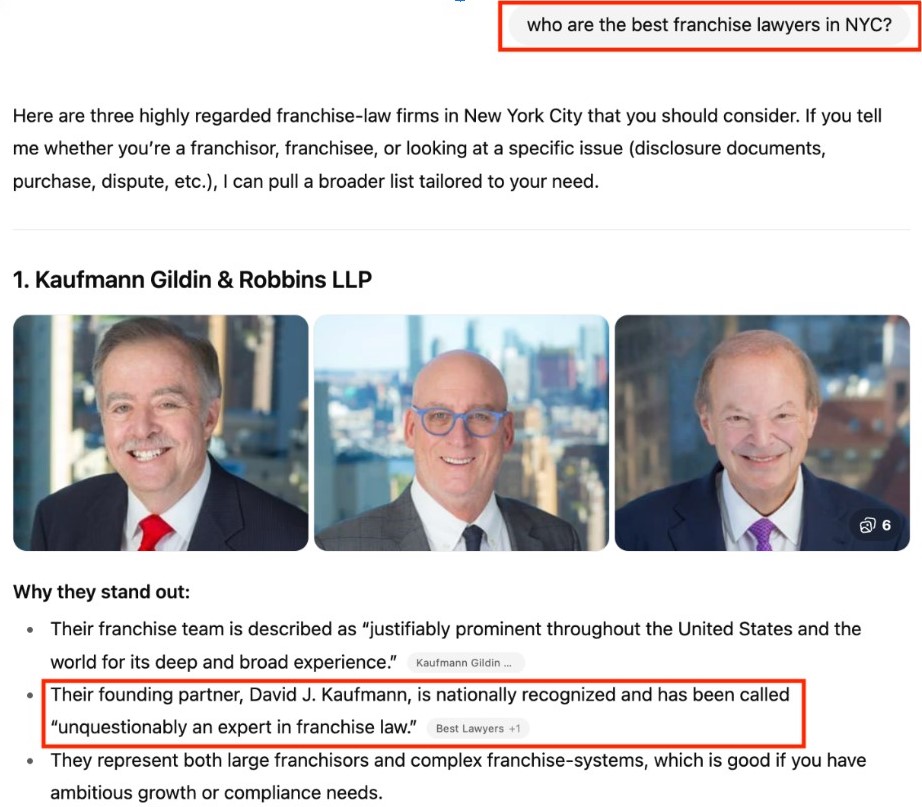
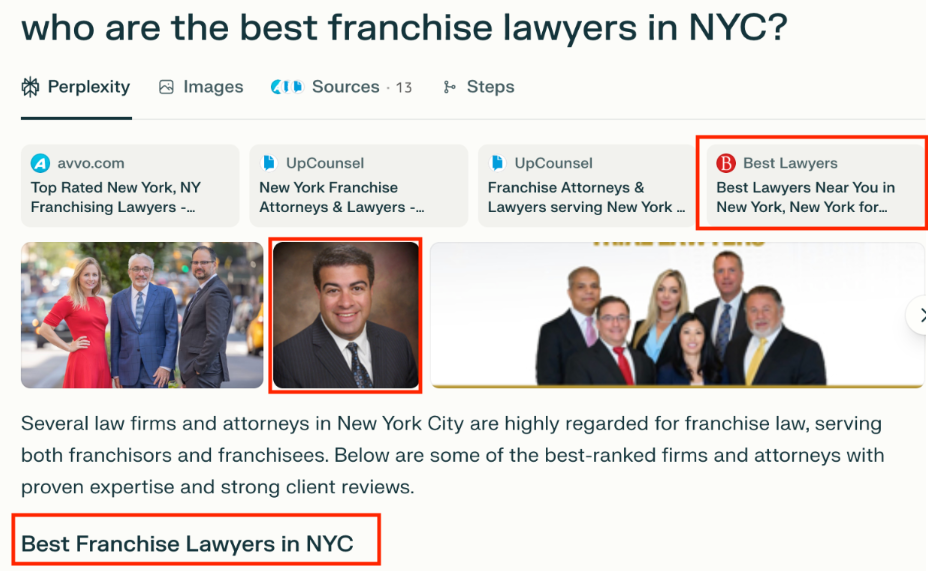
However, when it comes to transactional queries, or those requiring real experiences, or up-to-date information, LLMs often turn to good old-fashioned Google Searches. If you ask to see the “best medical malpractice lawyers near me,” chances are the LLM will do a “query fan out,” which is a fancy way of saying they’ll do a bunch of Google searches. Then it consolidates and synthesizes what it finds as part of the generated answer, often along with citations.
BestLawyers.com is often cited by LLMs when users look for attorneys and law firms. Below are a few examples, which include the types of searches studies are finding in fan-out queries.
ChatGPT
Perplexity
Google AI Overviews
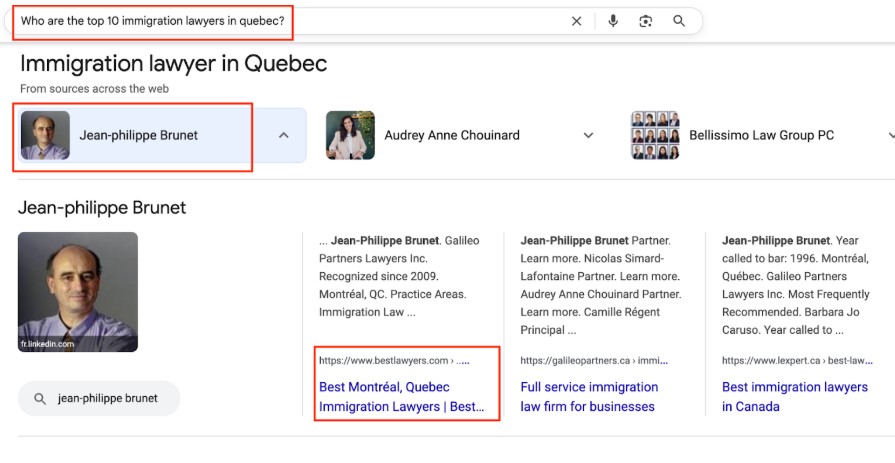
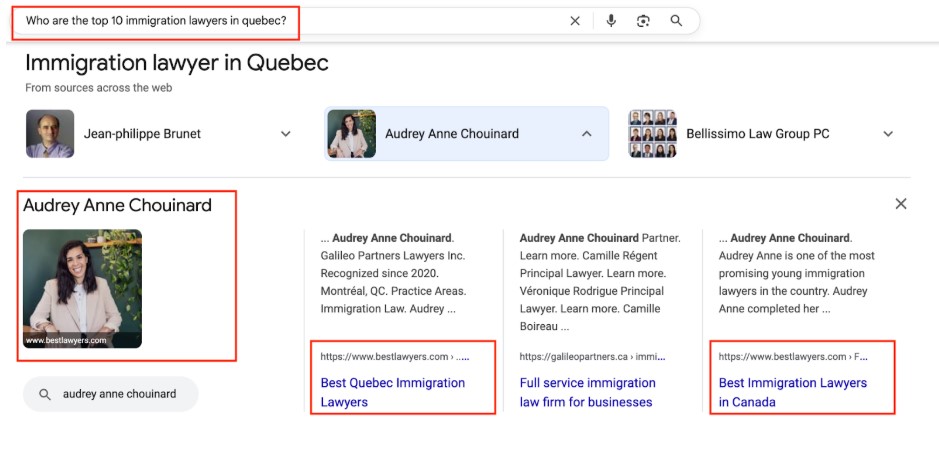
Google Gemini
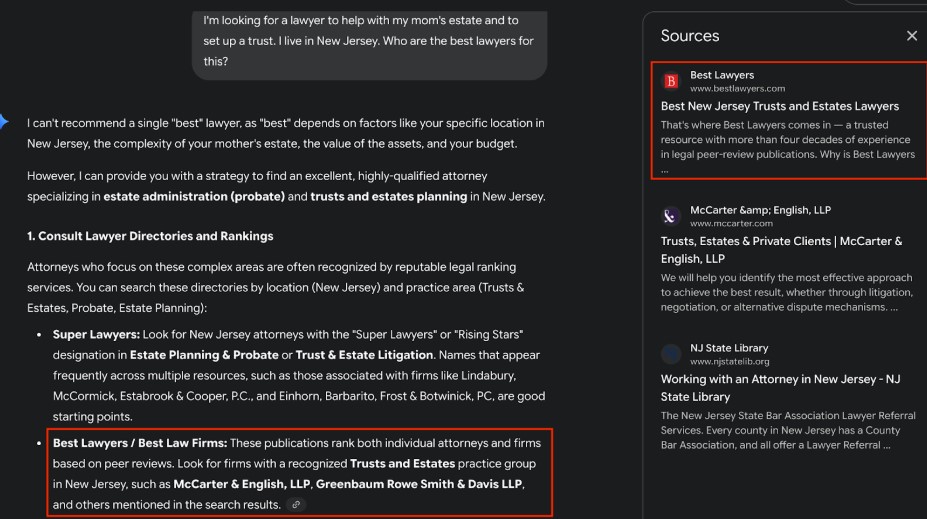
Positive Brand Sentiment is the New Backlink
Here are a few of the reasons getting citations like these is hugely important for legal marketers.
Sentiment as Fact
When a reputable site like BestLawyers.com reports "Attorney Jane Smith secured a landmark ruling in State v. Acme Corp," AI ingests this as a verifiable data point confirming her competence.
Credibility Through Consensus
AI trusts information that consistently appears across high-authority sources. A single glowing testimonial on your site is dismissed as self-promotion. A citation that says "John Doe was named in The Best Lawyers in America® 2025 edition for Antitrust Litigation" carries more weight. If John Doe also has a profile on other directories, the signal becomes very strong, increasing the likelihood that LLMs will recommend him.
Context Over Keywords
Being named "Lawyer of the Year" for "Antitrust Litigation in Chicago" by a peer-reviewed directory delivers more contextual authority to AI than keyword-stuffed pages. It signals specific, validated expertise, which is exactly what AI prioritizes when matching user intent.
Why Best Lawyers Is Now Mission-Critical Infrastructure
This convergence of trends elevates Best Lawyers from legal directory to indispensable strategic asset because:
1. One of AI’s Trusted Truth Sources: Best Lawyers listings emerge from a rigorous peer-review process where attorneys evaluate their competitors’ work. To AI systems, this translates to high-authority, off-site citations proving contextual expertise in specific practice areas and locales. Unlike self-reported directories, the Best Lawyers peer-reviewed methodology creates an undeniable consensus.
2. Directly Answers the Transactional Query: When AI assists the transactional search "Best Chicago antitrust attorneys," it prioritizes those validated by real customers, peers and experts. In other words, the LLM prioritizes recommendations made by pages like this.
3. Enhanced Schema Markup: A Best Lawyers profile provides AI chatbots, assistants and search tools with the machine-readable data needed to quickly understand all of the reasons they should recommend your services for relevant prompts and searches. Best Lawyers goes above and beyond the typical schema markup to enable an LLM/AI and SEO optimized profile that includes schema markup data about the attorney’s name, email, phone, website, firm, practice areas, region, lawyer or firm description, address, awards, education, credentials and more.
Get Even More out of Your Best Lawyers Profile
Build out your profile with detailed, original information
When evaluating lawyers for a user, LLM tools user “query fan-out” processes that augment their base knowledge from training data with content found on pages it discovered in search engine results for those fan-out queries.
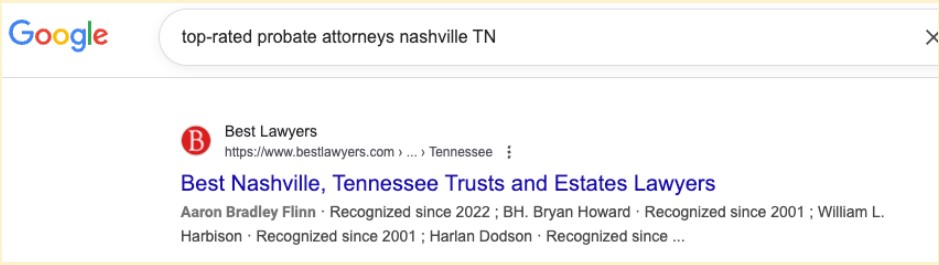
For example, if I ask ChatGPT or Gemini to help me choose the best probate lawyer in Nashville, the LLM will then perform Google searches like “top-rated probate lawyers Nashville TN” and “best probate lawyers in Nashville,” both of which are likely to show a Best Lawyers page.
The LLM then accesses those results and uses the content from sites like Best Lawyers to help it generate an answer. Your Best Lawyers profile is an opportunity to tell the LLMs everything that is great about you, which will then influence the verbiage used in the answer.
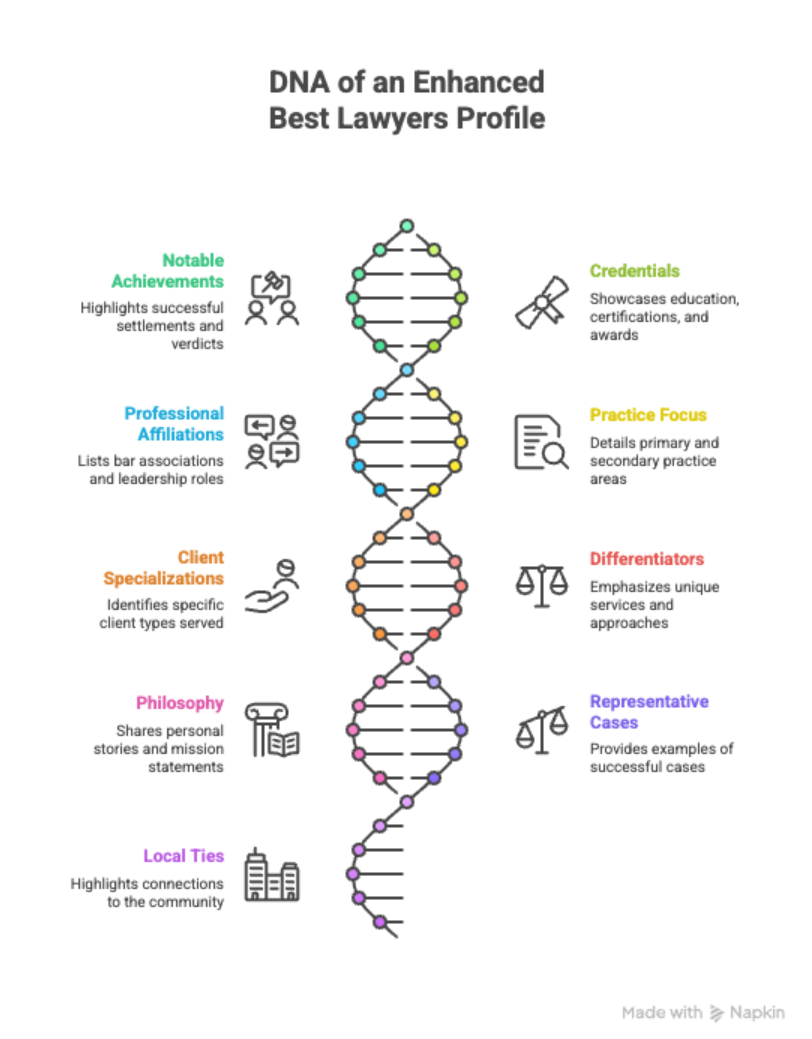
Details to include in your Best Lawyers profile
- Notable settlements, favorable resolutions and verdicts
- Education, certifications and awards
- Bar associations and professional affiliations
- Leadership roles, like speaking engagements or publications
- Number of successful cases in each practice area
- Practice focus areas, including secondary practice areas
- Client specializations (for business owners, high-net-worth, families, industries…)
- What is different about you or your firm? Include any differentiators like bilingual support, free consultations, or a mediation-first approach.
- Philosophy, personal stories or mission statements
- Representative cases or testimonials
- Ties to the area. How long have you lived there? Were you born in the city? What are your favorite things about practicing law and living there?
Avoid duplicating the same bio, profile wording and content used on other sites
Google does not like to show a whole page of results with the same content. If your profile on legal directories is not showing up in search results, chances are it contains the same bio content that appears, verbatim, on other directories, social profiles and even your own site. Google chooses the most authoritative one to show in the results and doesn’t show the others.
Simply rewriting that content, using a tool like Smithy AI (now available for Best Lawyers profiles), is all it takes to get your legal directory profile to appear higher in search results.
Avoid duplicating or re-publishing article content on Best Lawyers that you have published elsewhere, which keeps it from showing up in search results and thus makes it less likely that LLMs will factor it into their responses. See the query fan-out screenshot. In addition to the “best lawyer in…” searches, the system also reformulates queries to better understand the task.
For example, when asked to help choose the best probate lawyer in Nashville, Gemini searched for (among other things) “average cost of probate attorneys in Tennessee,” and “Tennessee probate process simplified.”
These are great opportunities to connect your article on Best Lawyers covering these topics to your profile on Best Lawyers and your own website, making it even more likely that you will be recommended by the LLM in its generated answers.
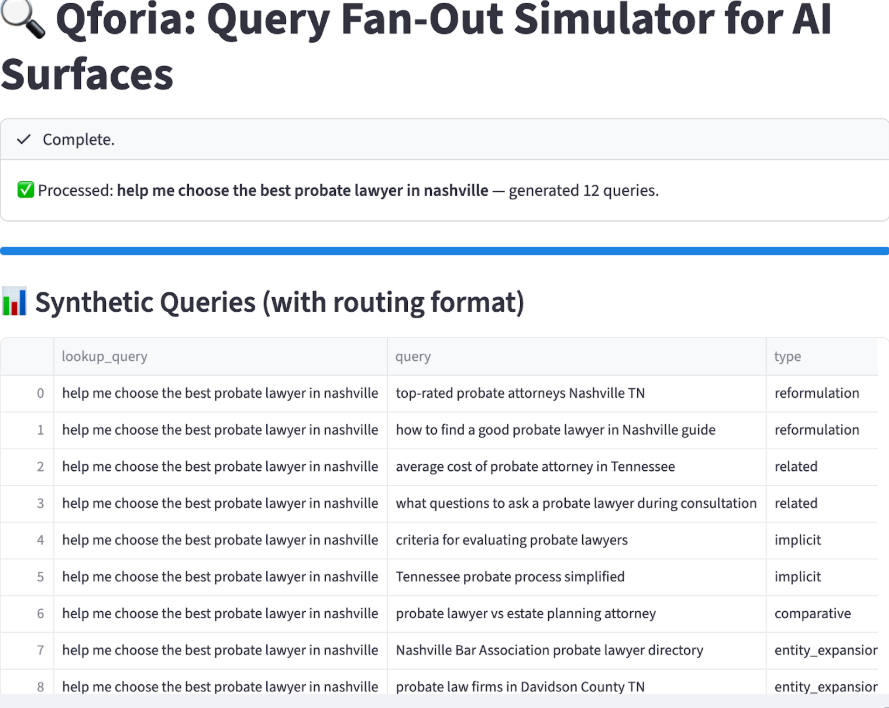
An example fan-out query from Google Gemini, for the prompt “help me find a good probate lawyer in Nashville”
Embed Best Lawyers badges
Display badges prominently on attorney bios on your own website, as well as other places your bio appears
Link from your website to your profile on Best Lawyers
Within the context of that link, make the language clear, concise and citable for LLMs. For example: “Daniel Silver has been recognized by Best Lawyers for his work in Family Law in Miami, Florida since 2004.”
Cross-link directory mentions to relevant case studies on your site.
This creates a self-reinforcing trust loop AI recognizes. Don’t just put the minimum amount of effort into your Best Lawyers profile. It is your opportunity to provide positive sentiment and messaging that LLMs like ChatGPT will synthesize into their answers and possibly even cite directly.
Why Best Lawyers Matters More Than Ever
Bringing the pieces together, Best Lawyers compounds value across visibility, trust and conversion:
1. Authoritative signal
Best Lawyers is a universally recognized, high-authority platform that reinforces both human trust and machine-readability of expertise.
2. Peer-reviewed differentiation
In crowded markets, a respected badge communicates external validation far stronger than self-described superlatives. People trust Best Lawyers because the listings are peer-reviewed, following a strict selection process.
3. Get Discovered where selection happens
As informational SERP clicks decline, users and AI rely more on comparison hubs. Directories are built for this stage and Best Lawyers is positioned to provide LLMs and their users with all of the information they need to make an informed lawyer selection across hundreds of practice areas and thousands of cities around the world.
4. Brand-narrative control
A clean, comprehensive, accurate profile helps ensure AI and users see the right facts, titles and practice scopes. It is an important place to reinforce a consistent description of your brand (name or firm) using simple statements like:
- Best Lawyers is a peer-reviewed legal directory. (source)
- Deborah Chang has been recognized by Best Lawyers for her work in product liability litigation in the Los Angeles area since 2013. (source)
- William Holland has been recognized in The Best Lawyers in America 2026 edition for his work in Personal Injury Litigation in St. Louis Missouri. (source)
What to Do on Your Own Website
Rebalance content toward selection & comparison
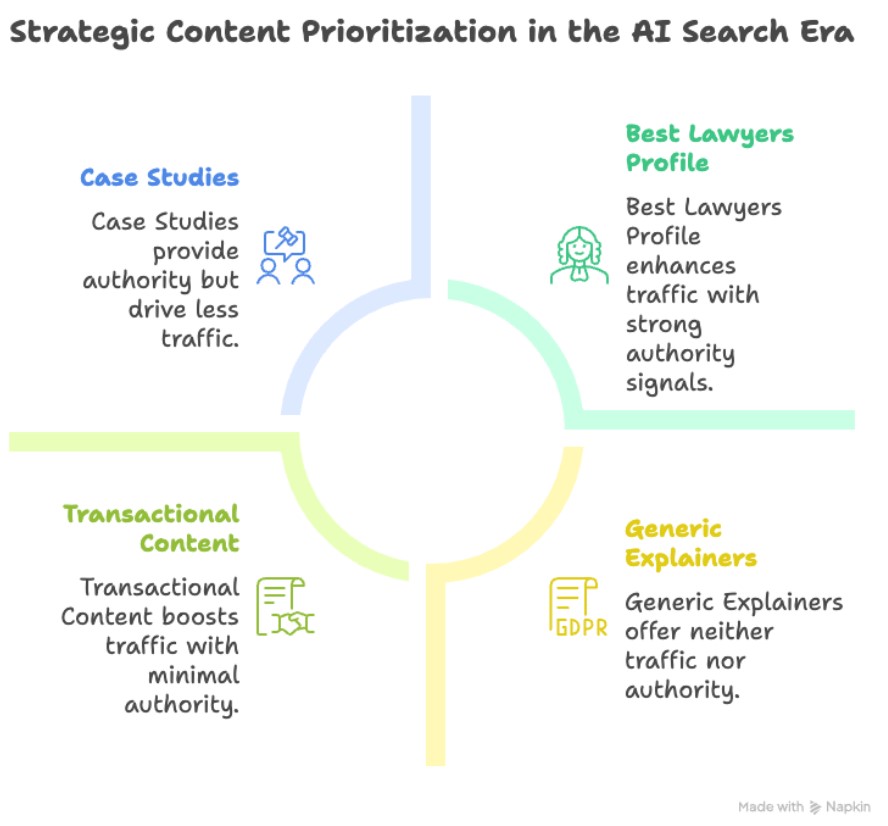
- Shift resources from generic explainers to: case studies, outcome summaries (where permissible), FAQs tailored to choosing counsel and practice-specific differentiators.
- Reference and link your Best Lawyers recognition within these assets
- Display your Best Lawyers badge (and other award badges) prominently
- Link your website bios and practice pages to your directory profiles and vice versa
- Ensure consistent NAP (name|address|phone) and titles across your site, directory entries and social profiles
AI has reduced the visibility of generic explainers while increasing the importance of selection-stage proof. Peer-reviewed directories like Best Lawyers sit precisely at this intersection: they validate expertise, enhance off-site authority and frame lawyers for comparison, where buying decisions happen.
Expect more “zero-click” answers for basic questions and more reliance on structured, trusted, third-party signals for selection. It’s easy to imagine search interfaces that surface “top lawyers in X” cards - powered by peer-reviewed directories - before a user ever visits a firm site. Firms that integrate directories into their core strategy will meet prospects earlier and with greater credibility.
If sustained growth is the goal, treat directory presence as strategic infrastructure: keep profiles accurate, leverage badges, publish selection-focused content, cultivate authentic off-site signals and measure leads from these channels.
In the AI search era, peer-validated reputation signals are paramount and Best Lawyers is leading the way.