Good SEO is good AIO (source: Google), so you should keep doing what you’ve always done, but add some of the strategies and tactics we’ll discuss below.
This AI marketing guide assumes you have a working knowledge of SEO. It is written for law firm marketing leaders, SEO and AIO professionals who serve legal clients, and the lawyers who end up wearing the marketing hat at their own practice.
- Law firm leaders and marketing professionals face a sharp shift: about 68% of Google searches reportedly ended without a click in early 2026.
- AI recommendations now matter more than citations, making clear firm identities, consistent facts and third-party mentions essential for visibility.
- Practical audits can uncover blocked content, JavaScript issues, outdated claims and conflicting information before they cost opportunities.
- Use the guide’s actionable framework to improve AI discovery, strengthen credibility and focus marketing on potential clients, not clicks.
The Decline in Informational Search Traffic
For more than a decade, the playbook for organic search acquisition focused heavily on top-of-funnel keywords with high search volume and informational intent. Examples include keyword phrases like “what to do after an auto accident” or “how to get a divorce in Ohio”.
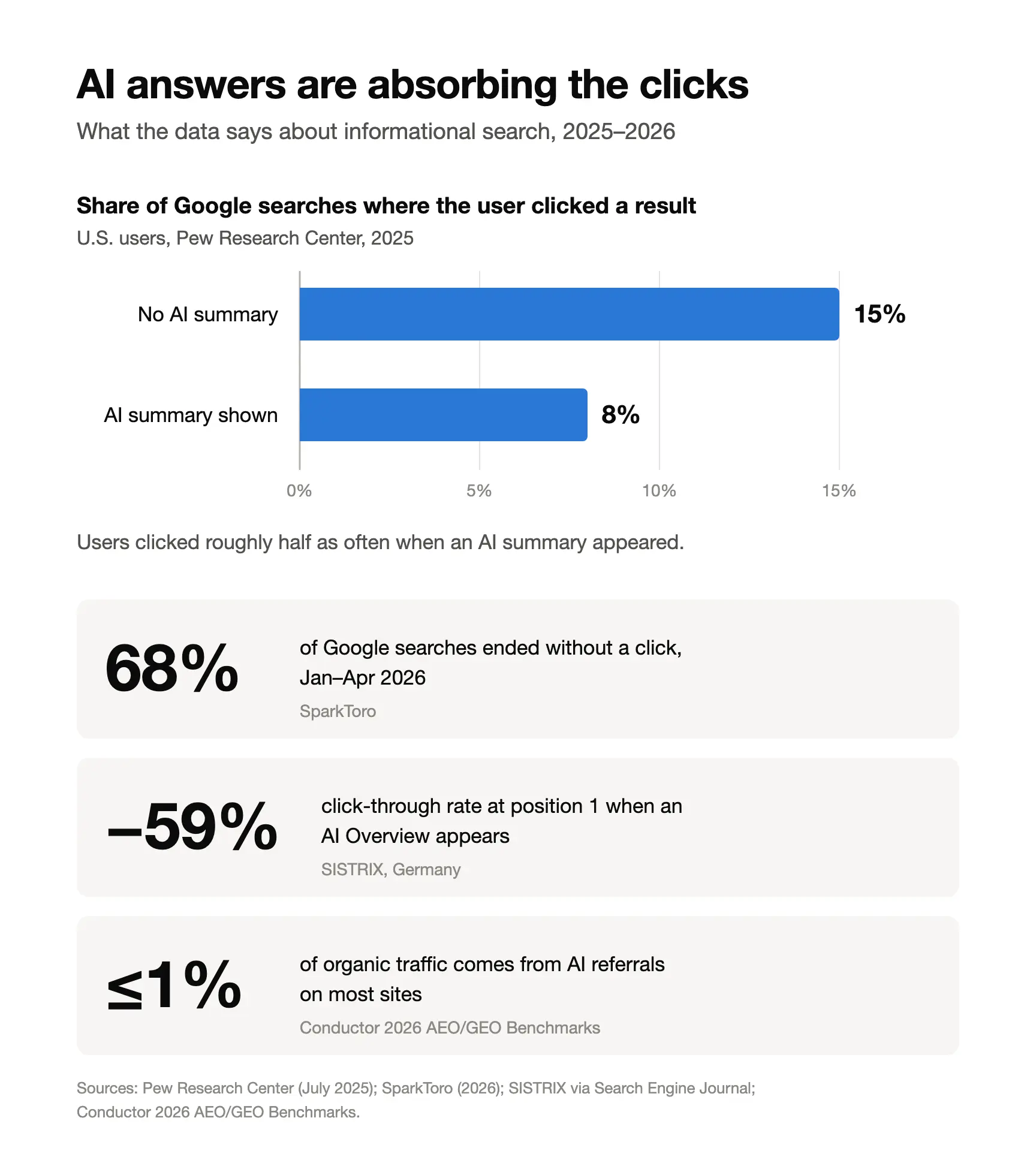
Users no longer have to visit websites to get answers to such questions, which has caused massive traffic loss from organic search to most commercial websites. We’re talking upwards of 60% to 80% loss of traffic for some law firms. Roughly 68% of Google searches ended without a click in the first four months of 2026, and the figure has been climbing ever since (source: Sparktoro / Rand Fishkin).
The good news is that, at a certain point, someone still needs to contact a law firm. They may not be reading informational articles on commercial websites anymore, but AI-based information retrieval has not eliminated the need for legal representation. So, how do you make sure yours is one of the firms they choose? That is what the rest of this guide covers.
The 5 Pillars of AI Marketing for Law Firms
- Technical SEO
- Brand 7 Optimization
- Information Fidelity
- Strategic Wording
- Expertise, Experience, Trust and Authority (EEAT)
We’ll cover each of these in more detail throughout this guide. For starters, here is an outline of each pillar:
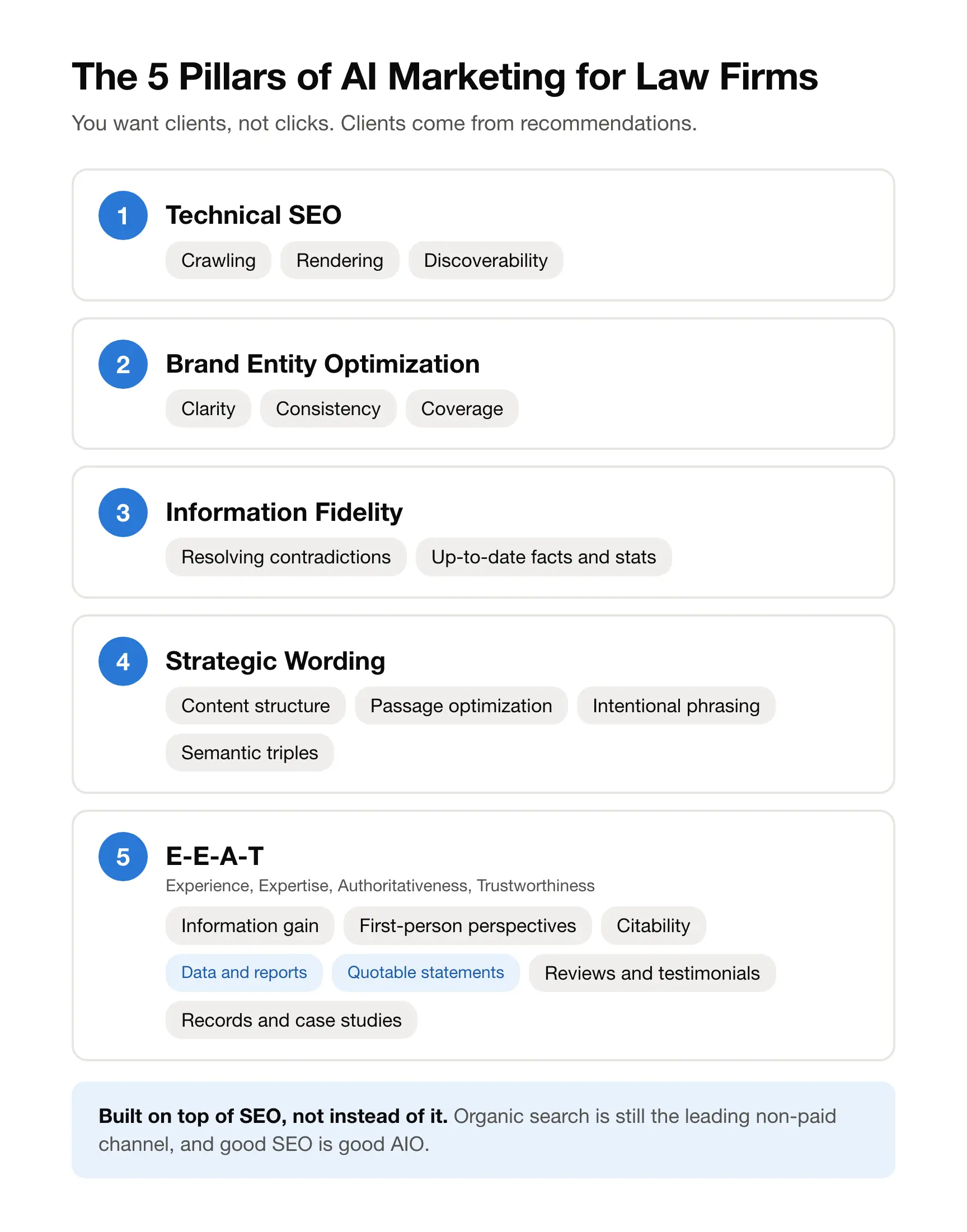
Before we get into specific strategies, let’s get clarity on what the goals are. You want clients, not clicks. Clients come from recommendations.
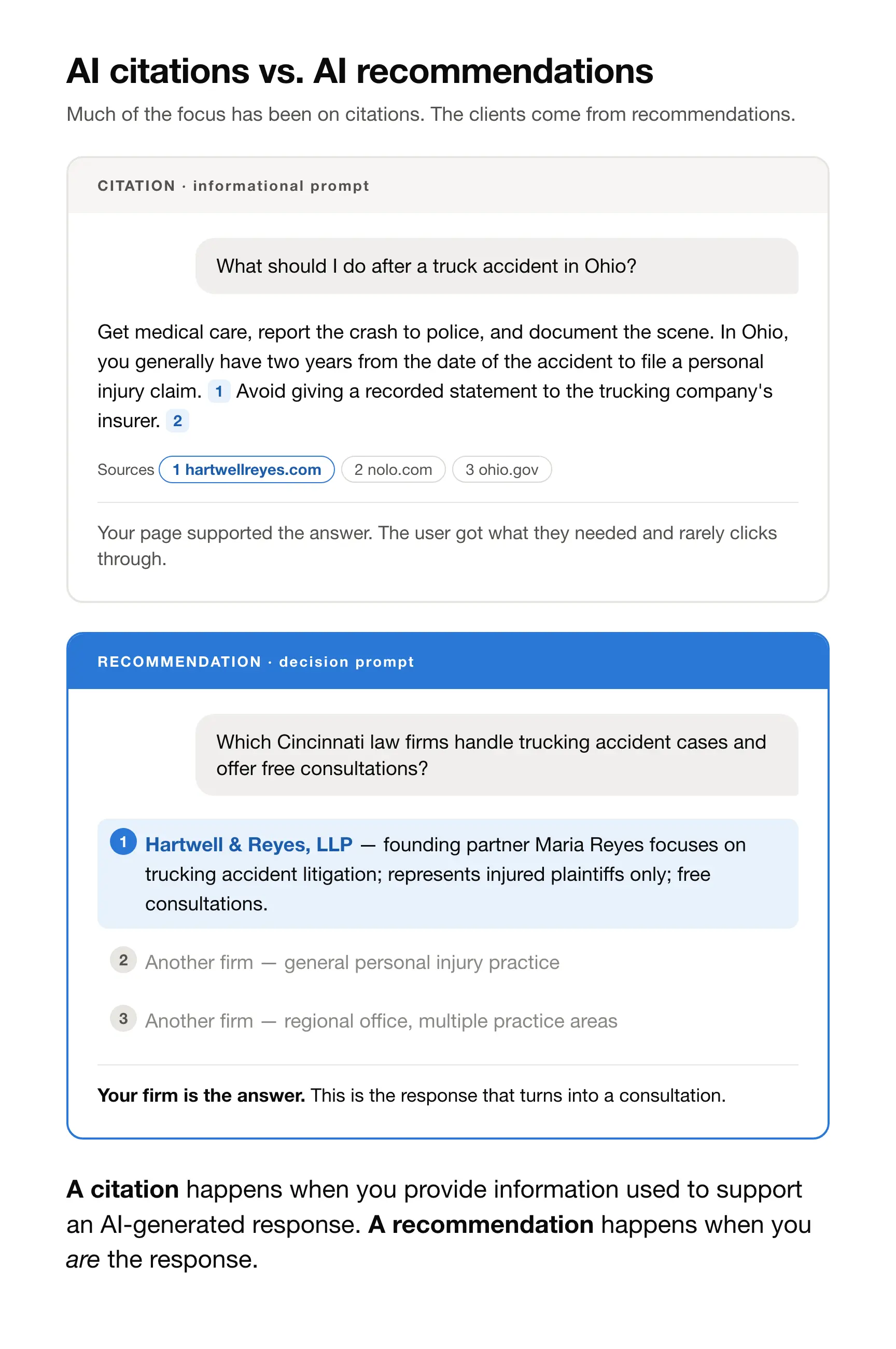
AI Citations Vs AI Recommendations
Much focus has been placed on getting AI citations, but those rarely result in new traffic to your website. Even if you do manage to get cited in one of Google’s AI Overviews (AIO), for example, the chance of getting a click from that citation is small. SISTRIX reported a 59% drop in click-through rate (CTR) at position one with AIOs, and Pew Research found that U.S. users clicked 8% of the time with AIOs versus 15% without (source: Search Engine Journal).
It is worth being one of the sources cited for informational Google searches, whether a human or an LLM is performing the search. However, your efforts might be better spent targeting recommendations. A citation happens when you provide information used to support an AI generated response. A recommendation happens when you ARE the response.
The best types of prompts to track are the ones that implicitly require a large language model
(LLM) to list out recommended law firms. For example, “Which law firms in Phoenix offer free consultations, and have experience with medical malpractice lawsuits,” or “Who are the best family lawyers in Denver”?
RAG and Query Fan-Outs
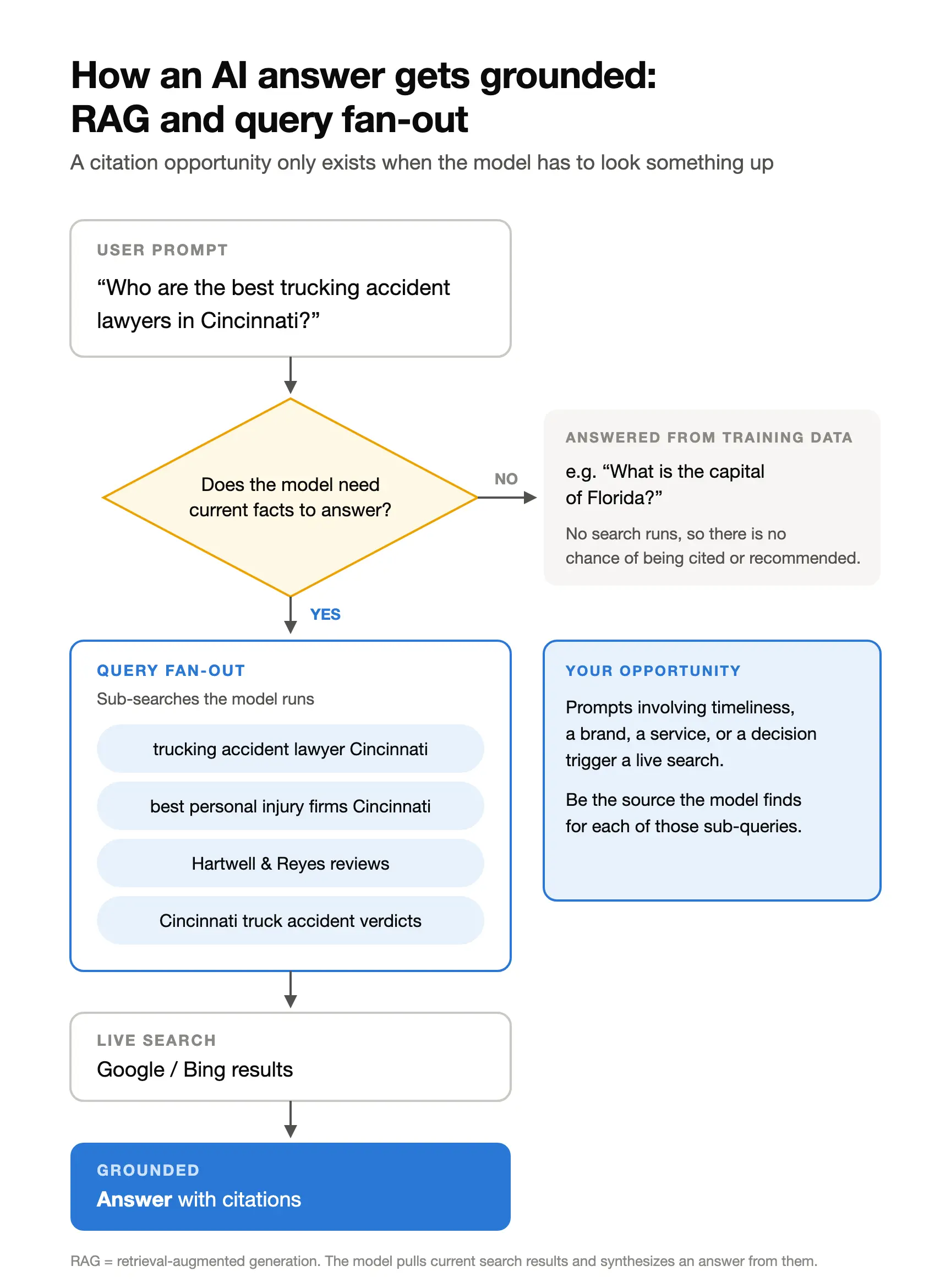
The mechanism behind AI citation is grounding. Most AI platforms, like ChatGPT, Gemini, or Claude, will often use retrieval-augmented generation (RAG) to fact-check themselves before answering. RAG simply means that the model uses an external knowledge source to help it generate and validate an answer. Those knowledge sources could be anything, but for the purposes of this article, it can be thought of like this: ChatGPT essentially does a few Google searches (or Bing searches), pulls current search results and synthesizes an answer from what it finds.
The sequence of related searches to help ground their answer are known as “fan-out queries”. This happens when the system determines that additional retrieval is needed.. A simple factual question that the model already knows the answer to (e.g. what's the capital of Florida) won't be grounded in a live search, so there's no citation opportunity at all. But a question involving timeliness, a brand, a service or a decision (e.g. who are the best malpractice attorneys near me) may prompt the model to go find current information. That's where a law firm has a chance to be the source it finds.
[Internal link: AI Changed Legal Search. The Legal Industry Is Still Playing Catch-Up and The AI Search Revolution and How It Affects Legal Marketing — both go deeper on this behavioral shift.]
Helpful Query Fan-Out Tools for AI Marketing
- Qforia (iPullRank): A free interactive scorecard that scores your AI-search readiness across content, technical SEO, authority, measurement and execution, and returns a maturity score with prioritized next steps.
- AI Coverage / Query Fan-Out Tool (Locomotive Agency): Fans a target query out into the sub-queries an AI system would generate, then scores how completely a given page covers that expanded set.
Technical SEO
Technical SEO comes down to ensuring your website is discoverable and crawlable, and that the content can be accessed and viewed, even without JavaScript enabled. Not only do the same technical SEO strategies still matter for AI marketing. They’re actually more important now than they were before AI Overviews hit the search results, or ChatGPT was a household name. There are two primary reasons for this:
SEO is Still Important for AIO
AI systems may perform searches on Google or Bing to ground their answers in up-to-date facts because they do not keep an index of the web like Google does for its traditional search results.
AI Agents are even worse at executing JavaScript than Googlebot.
It is important that all of the content and navigation on your law firm’s website is accessible without JavaScript enabled. Many AI agents, including those used by ChatGPT and Claude, are not capable of rendering JavaScript(JS) on their own. Additionally, CommonCrawl, which crawls the web and provides the content used by many LLMs for training their systems, does not render JavaScript content.
Does your content render without JS?
Use the Rendering Difference plugin or AI Eyes plugin for Chrome to compare your page content with and without JavaScript. Alternatively, use Chrome Inspect mode, then click CTRL+Shift+P, search for “JavaScript,” and select “Disable JavaScript,” then reload the page to see what it looks like to many AI agents and crawlers. Here’s a more detailed guide.
We won’t rehash the basics of technical SEO here. Just know that all of the tools and tactics SEOs have used for the past decade are still vital for AI marketing. These include things like sitemaps (XML and HTML), backlinks, and server-side rendering.
In short, make sure your website is crawlable, discoverable, and that the content is accessible without JavaScript.
Helpful Technical SEO Tools for AI Marketing
- JavaScript Rendering Check (SearchVIU): Shows what different crawlers and user agents actually see on a page, raw HTML versus fully rendered. Most AI crawlers don't execute JavaScript at all, so this flags content that's effectively invisible to them.
- AI Agent Access Tool (Dejan.ai): Checks your robots.txt against 144 known AI crawlers and generates a corrected file.
- AI Bot Access Analyzer: Simulates actual requests from major AI bots, catching CDN or firewall blocks that a robots.txt review alone won't show.
- Is It Agent-Ready (Cloudflare): Checks AI-agent-readiness factors. Use the "Customize scan" dropdown to select your website type first, or the score will ding you for factors that don't apply to a law firm site at all.
Legal Entity Optimization
Your law firm, or brand, is an entity. Each lawyer is an entity. Each legal practice area is an entity. An entity could be a person, place, thing, or concept. In AI marketing, the important thing for your law firm is that each of these entities is defined clearly and consistently, and that it has coverage in as many highly relevant places as possible.
Let’s start with clarity
Read each of the two passages below.
“Hartwell & Reyes LLP is a personal injury law firm based in Cincinnati, Ohio. Maria Reyes is a founding partner of Hartwell & Reyes LLP. Maria Reyes is licensed to practice law in Ohio and Kentucky. Maria Reyes specializes in trucking accident litigation. Hartwell & Reyes LLP represents injured plaintiffs, not insurance companies.”
The paragraph above is boring and repetitive, but it is clear, and uses semantic triples.
“For over two decades, our team has been fighting for people like you throughout the region. When the unexpected happens on the road, she knows what it takes, and we’ve been there for clients across state lines whenever they need us most. Big or small, we handle it all, because your story matters to us.”
At first glance, there is nothing wrong with the paragraph above. It is the type of content you might see on many law firm websites, and it is more engaging than the previous paragraph. However, it could be confusing to LLMs because “our team,” “she,” and “we” never resolve to named entities. “The region” and “across state lines” don’t name a location or jurisdiction. “What it takes” and “handle it all” don’t name a practice area. An LLM can’t confidently say who this firm is, where it operates, or what it does without referencing other content on the website or page.
The trick is to balance these two approaches. Let’s look at a third option, which uses semantic triples, names the entities (and their relationships to each other) but isn’t as boring as the previous version:
“For more than 20 years, Hartwell & Reyes LLP has represented injured people across Cincinnati, Northern Kentucky, and Southwest Ohio. Founding partner Maria Reyes, who is licensed in both Ohio and Kentucky, focuses her practice on trucking accident litigation, from jackknifed semis on I-75, to delivery van collisions on local roads. The firm represents only injured plaintiffs, never insurance companies, so every case Hartwell & Reyes takes on is built around the client’s recovery.”
The version above still reads like law firm marketing copy, but every pronoun has a clear owner, and the key facts are stated outright: who the firm is (Hartwell & Reyes LLP), who leads it (Maria Reyes), where it operates (Cincinnati, Northern Kentucky, Southwest Ohio), what it does (trucking accident litigation), and whom it serves (injured plaintiffs).
Consistency
It is important that facts remain consistent. This includes facts about your law firm or lawyers (both on your own site, and others).
Ask each major AI tool to describe your law firm. Ask what practice areas you specialize in, when the firm was founded, who the partners are and any other factual information it can find. Then audit those responses for accuracy and consistency. For anything inaccurate or inconsistent, ask the tool to show its sources so you can get the information corrected. Sometimes that’s as simple as logging into a lawyer directory account or updating content on your own website. Other times, you may need to contact another publisher and ask them to correct what they’ve written about your firm.
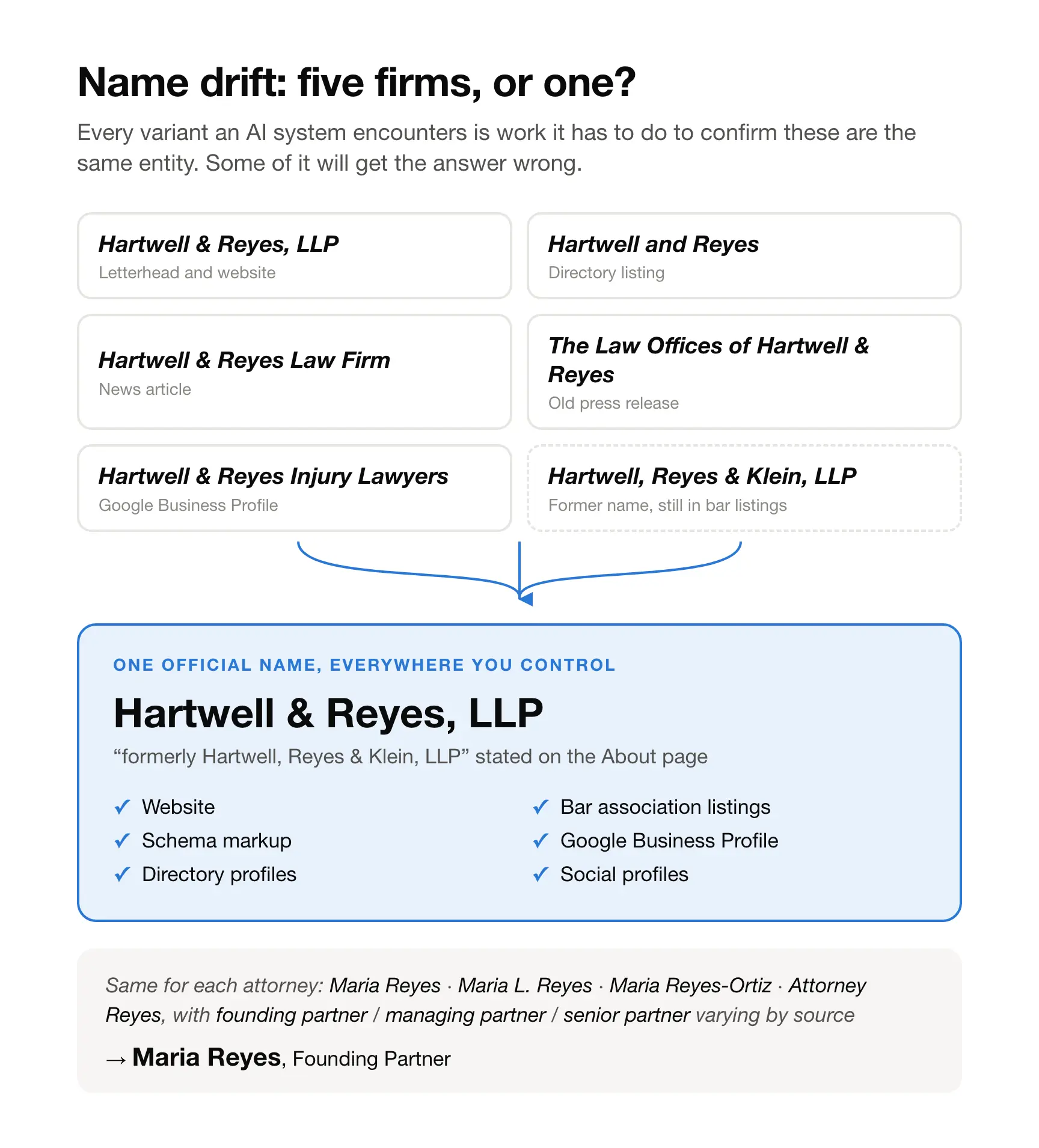
Be consistent when describing your law firm. Law firm and attorney names are especially prone to drift across websites and directories. Hartwell & Reyes, LLP might appear as Hartwell and Reyes, while Maria Reyes may be listed as Maria L. Reyes. Firm name changes and inconsistent attorney titles can add to the confusion. Keep these details current and consistent wherever possible.
Choose one official version of your firm’s name and each attorney’s name, and use it everywhere you control: your website, schema markup, directory profiles, bar listings, and social profiles. If your firm has changed its name, say so explicitly on your About page (for example, “Hartwell & Reyes, LLP, formerly Hartwell, Reyes & Klein, LLP”), so AI systems can connect the old name to the new one rather than treating them as two different firms.
Helpful Tools for Entity Optimization
Coverage
One of the biggest differences between traditional SEO and AI visibility is the potential value of unlinked mentions. In SEO, a nofollow link or a mention without a link carried little or no ranking value. LLMs work differently. They learn associations from text, so every time your firm’s name appears alongside a practice area and a location, whether or not there’s a link, it reinforces the connection. If Hartwell & Reyes, LLP appears on enough lists of top Cincinnati personal injury firms, an LLM becomes more likely to include it when someone asks for recommendations.
Start by asking the AI tools themselves. Prompt ChatGPT, Gemini, Perplexity and Copilot with questions like “Who are the best trucking accident lawyers in Cincinnati?” and look at which sources they cite. Then search for “top {practice area} law firms” and “best law firms in {location}” to find the lists, directories, and articles that rank for those queries. Those are your targets. Pursue inclusion on as many credible lists as you can, prioritizing the ones AI tools already cite.
Do the same with your case results. Publish significant verdicts and settlements on your own website, but also distribute them through press releases, legal news outlets, local business publications and bar association newsletters. Each placement is another independent source connecting your firm’s name to the type of case you want to be known for.
A resource like aHref’s Link Overlap tool can also be helpful in uncovering domains that link to multiple competitors, but not to your firm.
Information Fidelity
Maintaining information fidelity is all about resolving contradictions and keeping facts and stats up-to-date.
Consistent Factual Claims in Content
Microsoft Bing's Krishna Madhavan has talked publicly about the platform's shift from ranking pages for humans to grounding AI answers directly. Part of that shift is a practice he calls abstention: declining to cite or answer at all when the underlying evidence is missing, stale, or conflicting.
One page says intake takes two weeks, another says thirty days; a cost figure differs across three explainer articles. Individually small. Collectively, it erodes the kind of trust a grounding system is built to detect. Law firm sites, which tend to carry years of accumulated content on genuinely complex topics, are unusually prone to this.
There's a free tool built specifically for this problem called the Contradictory Claims Audit. It is a Google Colab notebook that takes a Screaming Frog export, uses Claude to extract the atomic factual claims from every page, pairs semantically similar claims that live on different URLs, and judges each pair as a genuine contradiction, a nuanced inconsistency, an agreement, or unrelated — then hands back a report and a CSV grouped by claim type (prices, timelines, eligibility, statistics, process steps).
Whether you use a tool, an AI agent or a manual review, make sure the facts on your website don't contradict each other. Sometimes two different things can be true. When that is the case, make it clear by outlining the circumstances.
Keeping Facts and Stats Up-to-Date
Law firm websites are full of numbers, and numbers go stale. The homepage says the firm has “handled more than 5,000 cases” or “recovered over $100 million for clients,” but those figures were written years ago and never updated. An attorney bio says Maria Reyes “has tried more than 40 cases to verdict” when the real number is now 60. The About page says the firm has “12 attorneys across 3 offices” when it now has 18 attorneys across 4 offices. Award badges from 2019 still appear as though they’re current.
Legal content goes stale too. A blog post explaining a damages cap, a filing deadline, or a court filing fee may have been accurate when it was published, but legislatures amend statutes and courts update fee schedules. Posts citing crash statistics, workplace injury rates, or other annual data (“Ohio saw 1,200 traffic fatalities last year”) lose their meaning as soon as the year changes.
It’s fine to keep older blog posts that covered news at the time, but pay attention to time-bound language. Phrases like “yesterday,” “this year,” “recently,” “currently,” and “the new law” should be replaced with specific dates, such as “in October 2023” or “the 2021 amendment to the statute.” For firm statistics, consider dating them explicitly (“As of January 2026, the firm has recovered more than $100 million for clients”) so that even an outdated figure is accurate in context.
The Contradictory Claims Audit tool can find many of these issues automatically. Another useful exercise is to crawl the site and export every page title and URL into a spreadsheet, then filter for years and months. This often surfaces outdated content, like “2019 Guide to Ohio Car Accident Claims,” that can be updated, consolidated with a newer post, or removed.
Strategic Wording
Content Structure
AI systems rely on structure to understand what a page is about and which part of it answers a specific question. Use descriptive headings that reflect the questions people actually ask, such as “How Long Do I Have to File a Wrongful Death Claim in Ohio?” rather than “Important Deadlines.” Put the answer directly beneath the heading, then add context and nuance afterward. Keep each section focused on one topic, and use lists or tables where the content is naturally comparative or sequential, like the steps of a personal injury case or the differences between Chapter 7 and Chapter 13 bankruptcy. A well-structured FAQ page or practice area page gives an LLM clean, labeled answers it can pull from with confidence.
Don't rely on a heading that says "Practice Areas" followed by a list. Literally write "Firm X handles cases involving medical malpractice, product liability and wrongful death."
Passage Optimization
AI search tools don’t always read a whole page. They often retrieve individual passages, a few sentences or a paragraph, and use those to ground an answer. That means each passage should make sense on its own. Avoid phrases like “as mentioned above,” “this type of case,” or “our attorneys” when the subject was named three paragraphs earlier. Instead, restate the subject: “In Ohio, families generally have two years from the date of death to file a wrongful death claim. Hartwell & Reyes, LLP handles wrongful death cases arising from trucking accidents throughout Southwest Ohio.”
Intentional Phrasing
Decide what you want AI systems to say about your firm, then say it that way, consistently, everywhere. Think of it as your firm’s signature claims: the short, specific statements you’d want an LLM to repeat when someone asks about you. For example:
- “Hartwell & Reyes, LLP has taken more than 60 trucking accident cases to trial.”
- “Voted Best Personal Injury Firm in Cincinnati by Cincinnati Magazine readers in 2025.”
- “Maria Reyes is board certified in truck accident law by the National Board of Trial Advocacy.”
- “Hartwell & Reyes, LLP has represented injured plaintiffs in Ohio and Kentucky since 2004.”
Notice that each claim is specific, verifiable, and tied to a named entity. Vague claims like “experienced trial lawyers” or “award-winning firm” give an LLM nothing distinctive to repeat. A specific number, a named award and a date do.
These claims shouldn’t live only on your website. Use the same wording in your directory profiles, your Google Business Profile description, LinkedIn and other social profiles, attorney bios on bar association sites, speaker bios, and press release boilerplate.
A practical exercise: ask yourself, “When someone asks ChatGPT about our firm, what three sentences do we want it to say?” Write those sentences down, make sure they’re accurate and current, and then audit every profile you control to make sure they appear.
Note: claims like “voted best” or “most successful” can run into Rule 7.1 issues if they’re unsubstantiated or create unjustified expectations. Naming the awarding organization and the year, as in the examples above, makes the claim compliant and more useful to an LLM.
Semantic Triples
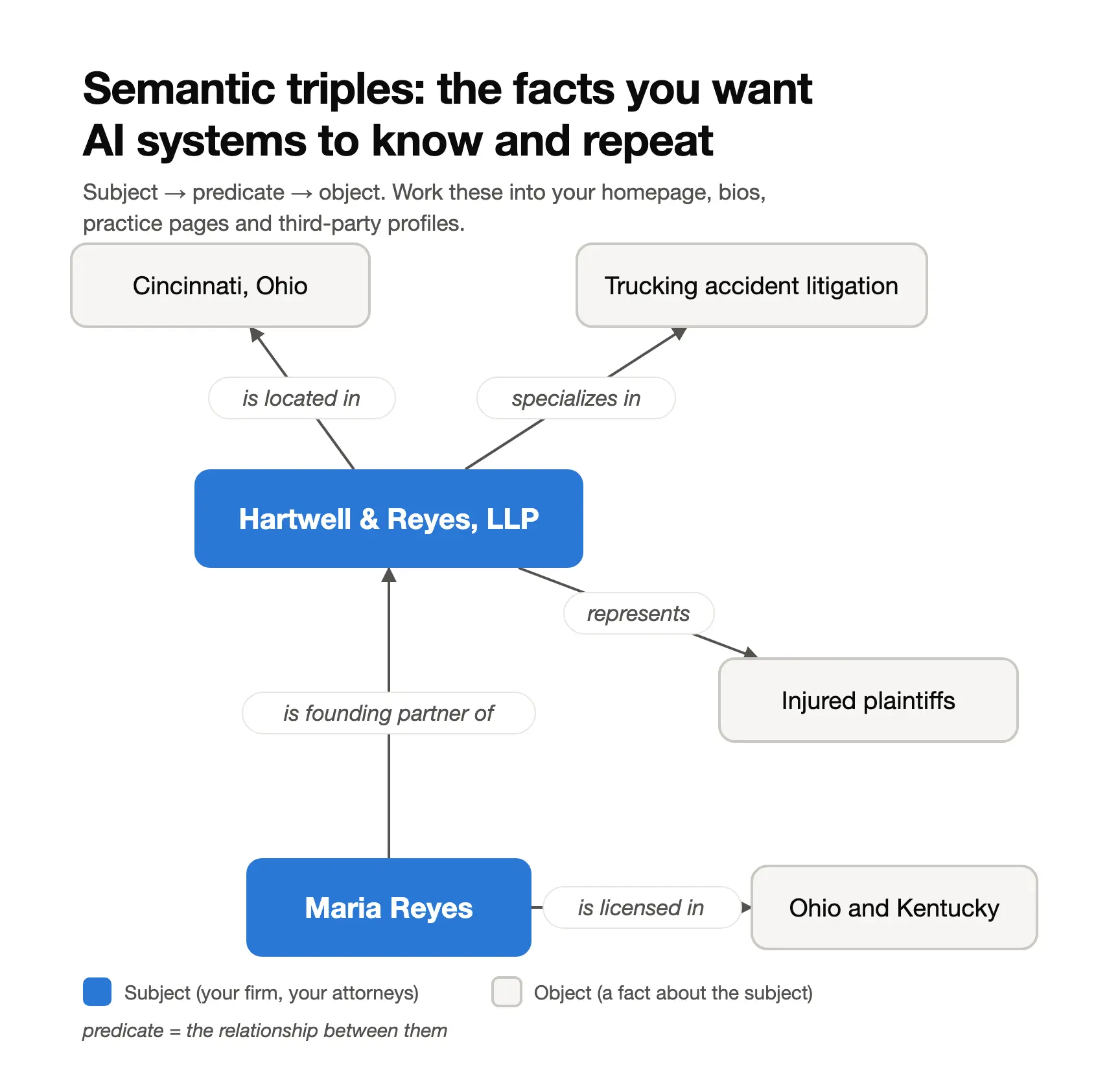
We looked at how semantic triples (subject, predicate, object) make facts easy for an LLM to extract. A useful exercise is to build a list of the core triples for your firm and work them into your content intentionally. For example:
- Hartwell & Reyes, LLP → is located in → Cincinnati, Ohio
- Hartwell & Reyes, LLP → specializes in → trucking accident litigation
- Maria Reyes → is founding partner of → Hartwell & Reyes, LLP
- Maria Reyes → is licensed in → Ohio and Kentucky
- Hartwell & Reyes, LLP → represents → injured plaintiffs
These are the facts you most want AI systems to know and repeat about your firm. They should appear consistently across your homepage, attorney bios, practice area pages, and third-party profiles, written naturally rather than word for word, so they read well for people while still reinforcing the same relationships for machines.
Experience, Expertise, Authority and Trustworthiness
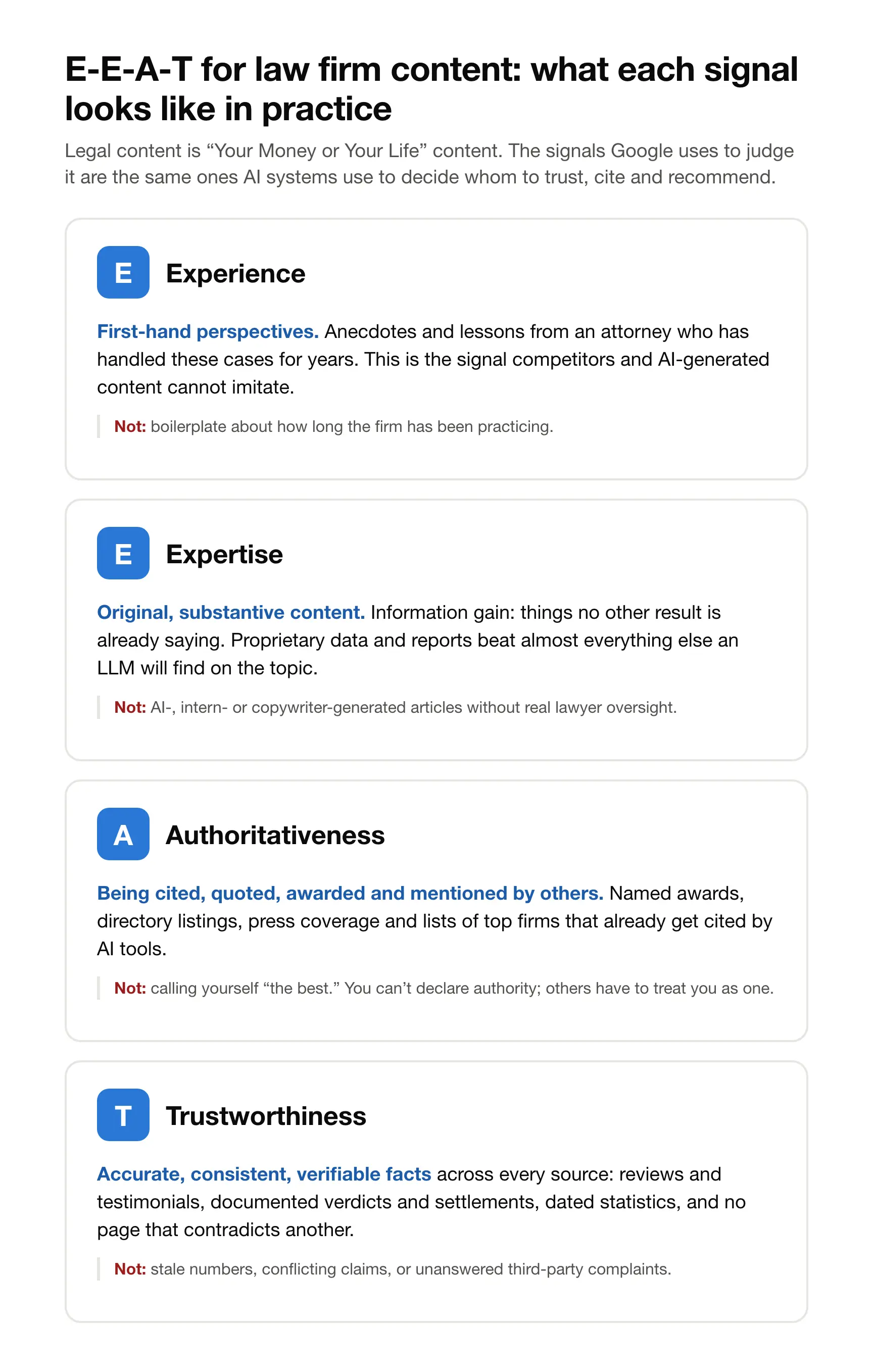
Google’s E-E-A-T framework was designed to help evaluate content quality for “Your Money or Your Life” topics, and legal content sits squarely in that category. The same signals that help Google judge whether a law firm’s content is credible also help AI systems decide which sources to trust, cite and recommend.
- Experience shows up in first-hand perspectives, not just language about how long a lawyer has been practicing, or how many cases they’ve taken to trial.
- Expertise shows up in original, substantive content that wasn’t written by AI, marketing interns or copywriters - at least not without significant lawyer oversight.
- Authoritativeness comes from being awarded, cited and mentioned by others.
- Trustworthiness comes from accurate, consistent, verifiable facts, which ties back to everything covered earlier in this article.
Here are some other ways to establish EEAT
Provide Information Gain: Original content is one of the clearest demonstrations of expertise, because it shows knowledge that goes beyond what anyone could compile from other websites. Information gain means providing useful information that every other result isn’t already saying in various ways. If you can contribute proprietary data with statistics and a report, that beats 99% of what the LLM is going to find on the topic elsewhere.
Give First-Person Perspectives: This is the “Experience” in E-E-A-T, and it’s the hardest signal for competitors or AI-generated content to imitate. Anyone can ask ChatGPT or Claude to spit out an article about what to do after a car accident. What they can’t do is offer unique first-hand experiences and anecdotes from an attorney who has dealt with such cases for many years.
Citability: Being cited, quoted and referenced by other sources is how authoritativeness is built. You can’t declare yourself an authority; others have to treat you as one.
Reviews and Testimonials: Reviews are third-party evidence of trustworthiness, from the people best positioned to judge it: your clients.
Records and Case Studies: Documented results provide verifiable proof of both expertise and experience. Verdicts and settlements are among the most persuasive facts a firm can publish, and among the most citable when they’re presented clearly
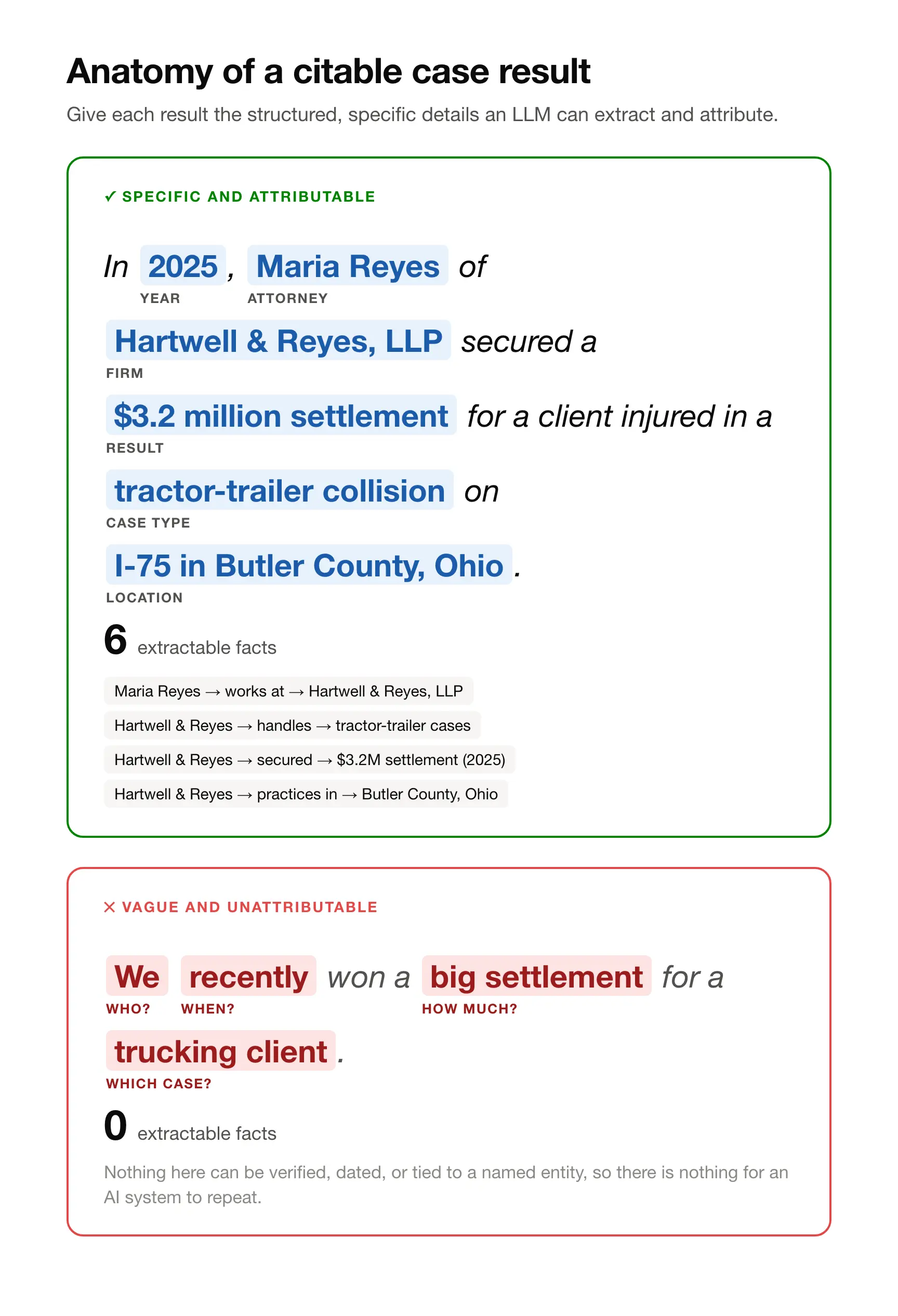
Give each significant result its own page or clearly separated entry, and include structured, specific details:
- Case type
Court or county - Year
- Amount
- Attorney
“In 2025, Maria Reyes of Hartwell & Reyes, LLP secured a $3.2 million settlement for a client injured in a tractor-trailer collision on I-75 in Butler County, Ohio” contains several semantic triples an LLM can extract and attribute. “We recently won a big settlement for a trucking client” contains none.
Common Reasons Law Firms Don't Appear in AI Results
Most of these are individually small technical or editorial gaps that compound:
- Non-semantic JavaScript-rendered content that's invisible to AI crawlers.
- Overly long, context-dependent content.
- Contradictory or stale facts across pages.
- Mismatched entity IDs in schema, which can make it harder to identify the firm
- Robots.txt or server-level blocks, sometimes accidental, that keep known AI crawlers out entirely.
- Ignoring SEO fundamentals like title tags and internal linking
- Lack of third-party support (you say you’re “the best” but nobody else does)
- Third-party complaints, like Reddit threads or Google reviews disparaging the firm
FAQs
Does llms.txt help my law firm get cited by AI?
Not based on current evidence. There is limited evidence that llms.txt improves AI citation visibility. It doesn't hurt to have one, but don't treat it as a priority.
Do I need advanced schema markup for AI search?
Cover the basics — Organization, Article, Blog, FAQ — well. Beyond that, custom schema is resource-intensive with limited evidence of payoff so far, since many AI systems read schema as plain text rather than parsing its structure.
How much traffic should I expect from AI platforms right now?
Roughly 1% or less of total organic traffic on most sites today. It's growing, but it isn't a channel to restructure your marketing budget around yet.
What's the single highest-leverage thing a small firm can do first?
Run a basic AI-visibility audit (Qforia or the AI Coverage tool are both free) and a JavaScript-rendering check. If the LLM can’t see your content, they can’t cite or recommend it.
Does Best Lawyers have any presence in AI search itself?
Yes — see Best Lawyers Launches ChatGPT App and How to Optimize Your Best Lawyers Profile for AI Search for how a directory profile fits into this same strategy.