

Prospective clients are increasingly turning to AI platforms such as ChatGPT, Perplexity and Google AI Overviews to find legal assistance. This reflects a shift in search behavior, not a decrease in demand for legal services.
Phil Greer, CEO of Best Lawyers®, observes, “It’s not like overnight people stop needing lawyers, stop needing doctors and dentists. They just started getting information from a different place.”
As clients rely more on AI to guide their choices, the way law firms are discovered and recommended is changing. Unlike traditional search engines, AI platforms do not rank websites.
Peer-reviewed recognition, structured professional data and third-party validation now determine which lawyers are surfaced. These markers of credibility align with the legal profession’s emphasis on trust and peer validation, which AI models increasingly recognize.
- AI is now a front door for clients. People still need lawyers, but discovery is shifting to tools like ChatGPT and Google AI Overviews.
- Traffic rules have changed. About 60% of Google searches end without a click and sites below AI summaries can lose up to 79% of traffic.
- AI does not rank firms by keywords. It surfaces lawyers with peer-reviewed recognition, third-party validation and consistent public data.
- Firms that strengthen verified signals and structured profiles gain visibility, credibility and a competitive edge as AI-driven discovery accelerates.
Traffic Trends in the AI Era
In 2025, about 60% of Google searches ended without a click, according to Up and Social. Users increasingly got answers directly from AI platforms, bypassing traditional search results. Gartner predicts that search engine volume could decline 25% by 2026 as chat-based discovery tools gain traction.
Authoritas Analytics found that a site previously ranked first could lose about 79% of its traffic if results appear below an AI overview. An AI overview is a summary generated by AI that provides direct answers to user queries instead of linking to multiple websites.
Pew Research Center reported that when AI summaries appear, users click traditional results only 8% of the time, compared with 15% when no summary is shown.
These trends highlight how information is delivered now shapes visibility. Firms with clear, verifiable credentials and consistent presence across trusted sources are more likely to appear in AI-generated recommendations, influencing client identification and engagement.
How AI Drives Online Discovery
The following factors explain how AI produces recommendations and why it is transforming the process of online exposure.
1. AI Produces Direct Recommendations
Traditional search engines provide a ranked list of results, shaped by credibility and relevance signals, leaving users to choose which sources to trust. AI platforms operate differently. Users can ask full, natural-language questions such as: "Who is the best provider for this need?” or “What organization is most trusted in this category?”
Instead of showing a page of links, AI generates a direct response that may include:
- Specific names or entities
- Summarized qualifications
- Contextual comparisons
- Referenced authority signals pulled from multiple sources
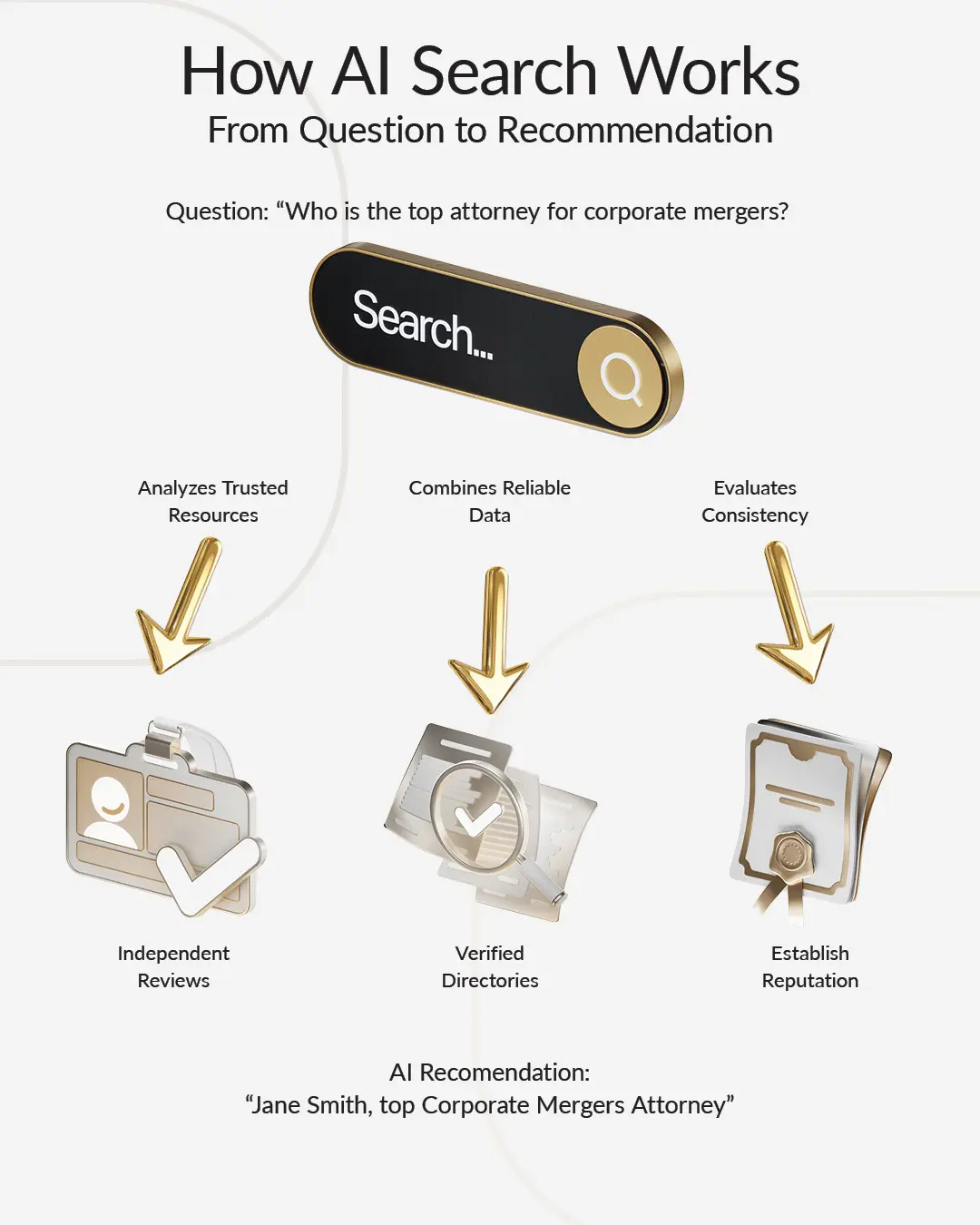
AI does not just list information. It combines, organizes and interprets multiple sources to produce a single coherent response. This transforms findability from a traditional “search and browse” model to an “ask and receive” format where users get the most relevant results without sifting through links.
2. AI Prioritizes Trust Over Keywords
AI systems do not rely on repeated keywords or traffic volume to determine what to show. They generate responses based on confidence and reliability. They evaluate sources by checking:
- Which sources are most consistent and reputable
- Whether information is confirmed across multiple outlets
- Whether claims are self-promotional or cannot be verified
At its core, AI is answering the question “Which sources are trustworthy enough to recommend?” Visibility now depends more on authority and verification than on the amount of content or traffic a site receives.
3. AI Relies on Verified Credibility Signals
AI models are designed to reduce incorrect or misleading outputs. As a result, they favor information supported by external validation rather than unsupported claims. These platforms look for trust indicators, including:
- Independent third-party recognition
- Peer-reviewed distinctions
- Trusted professional directories
- Structured data with transparent methodology
- Organizations consistently referenced across reputable sources
These markers give AI systems greater confidence in the information they surface and the sources they cite.
Authority Signals Matter More Than Content Volume
As AI becomes a primary way users find information, visibility depends less on the quantity of content and more on how easily a firm’s credibility can be verified. AI gives preference to sources that are recognized across multiple trusted outlets.
Key factors include:
- Independent third-party recognition
- Clear reputation markers
- Distinct, structured public-facing information
- Consistent presence across respected sources
Firms that invest in these elements are more likely to appear in AI-generated recommendations than those relying on content volume alone.
Why Legal Rankings Are More Critical Than Ever
AI models differentiate between self-promotional content and independently verified professional authority. Large language models or LLMs, analyze massive amounts of text to provide human-like answers based on authoritative sources.
Phil Greer, explains, “LLMs have been doubling down on sources of truth that are credible. Rankings like Best Lawyers are extremely important because they are backed by data and peer review.”
Third-party recognition provides AI systems with external credibility markers, giving them greater confidence when surfacing recommendations.
Not every listing signals equal authority. Those most likely to influence AI visibility share key attributes:
- Transparent methodology
- Independent evaluation
- Established trust within the legal community
These listings allow AI platforms to identify professionals who are consistently recognized by their peers. Lawyers with strong, independently verified rankings are more likely to appear in AI recommendations.
AI Discoverability Without Compromising Privacy
Law firms operate under strict privacy and privilege obligations. Marketing and AI surfacing strategies should focus only on information intended for public view.
Law360 reports that firms are reassessing AI use to ensure client confidentiality is not compromised. Proper review of public content before use in AI tools helps prevent accidental disclosure of sensitive information.
A clear governance framework helps separate data appropriately:
- Public-facing data: practice focus, recognitions, approved bios
- Internal-only data: strategic drafts, business development planning
- Restricted data: client matters, privileged communications
With defined boundaries, firms can improve AI presence while maintaining control over sensitive information and upholding client trust.
Checklist for AI Visibility and Data Governance
Law firms can take concrete actions to improve AI discoverability while maintaining control over content and confidentiality.
Key steps include:
- Audit AI presence: Review what AI platforms currently surface about your firm to understand your public footprint.
- Strengthen third-party authoritative signals: Highlight peer-reviewed recognition and other independent validations.
- Tailor bios: Replace templated profiles with practice-specific, differentiated content.
- Optimize structured data: Clearly organize and label website content, including pages, services and lawyer profiles, so AI models can understand your firm and surface it in recommendations.
- Publish client-focused content: Align articles, thought leadership and resources with real client questions and intent.
- Establish governance policies: Define internal guidelines for responsible AI use to protect sensitive and privileged information.
- Measure beyond traffic: Track AI referral mentions and instances where your firm is specifically recognized by name (branded discovery), along with engagement quality.
Smithy AI: Enhancing Attorney Profiles for AI surfacing
Across the legal market, many bios and firm profiles read alike, often because the same lawyer copies and pastes their description across multiple platforms.
This repetition is problematic: AI systems and clients struggle to distinguish between professionals and duplicated content can reduce visibility in recommendations or search results.
In environments where AI systems present information to clients, generic descriptions provide limited value, making it harder for systems to highlight meaningful differences between lawyers.
AI tools favor clarity and specificity, which puts a premium on profiles that highlight real, practice-focused expertise. As AI becomes a key channel for client identification and engagement, firms need to communicate professional strengths precisely, both to readers and the systems evaluating the information.
Smithy AI, introduced by Best Lawyers in 2025, addresses this challenge. The tool helps lawyers and firms create structured, distinctive public-facing narratives that improve AI visibility. Rather than generating generic content, Smithy AI strengthens how attorneys present their focus, experience and professional trustworthiness.
Notable features include:
- Legal-industry focus: Tailored for law firm content, not general-purpose AI
- Profile consistency: Helps reduce duplication across attorney bios and firm profiles
- Enhanced differentiation: Supports unique, practice-focused narratives while maintaining editorial control
- Credibility support: Works alongside third-party recognition to reinforce professional authority
- Announcement Toolkit integration: Streamlines multi-platform announcement communications across press, social media and email
Professional Standing in an AI World
AI will continue to shape how clients find legal services, placing greater emphasis on verified skills and professional standing. Firms that invest in durable recognition infrastructure through peer-reviewed distinctions, consistent public-facing information and distinct professional narratives are more likely to be surfaced reliably in AI-driven discovery.
Phil Greer emphasizes that maintaining this focus is essential and encourages firms to keep investing in their brand.
The takeaway is clear. AI does not replace professional authority. It amplifies the firms and recognitions that have already earned it.
Firms can explore the Best Lawyers Digital Marketing Platform to strengthen their public profiles and ensure their attorneys are recognized for their practice strengths.